[00:00:00] Speaker A: Welcome to Restaurant Talk, the podcast that pulls back the curtain on the industry with real stories and lessons every hospitality leader needs to know.
Sponsored by Save Fry Oil. Frylo cuts fry oil costs and makes food crispier. No power, no chemicals.
Now let's dive into this week's episode.
[00:00:30] Speaker B: Welcome, welcome, welcome to Restaurant Talk, the podcast that pulls back the curtain on the restaurant industry with real stories, hard won lessons and the grit every owner, operator and hospitality pro knows by heart.
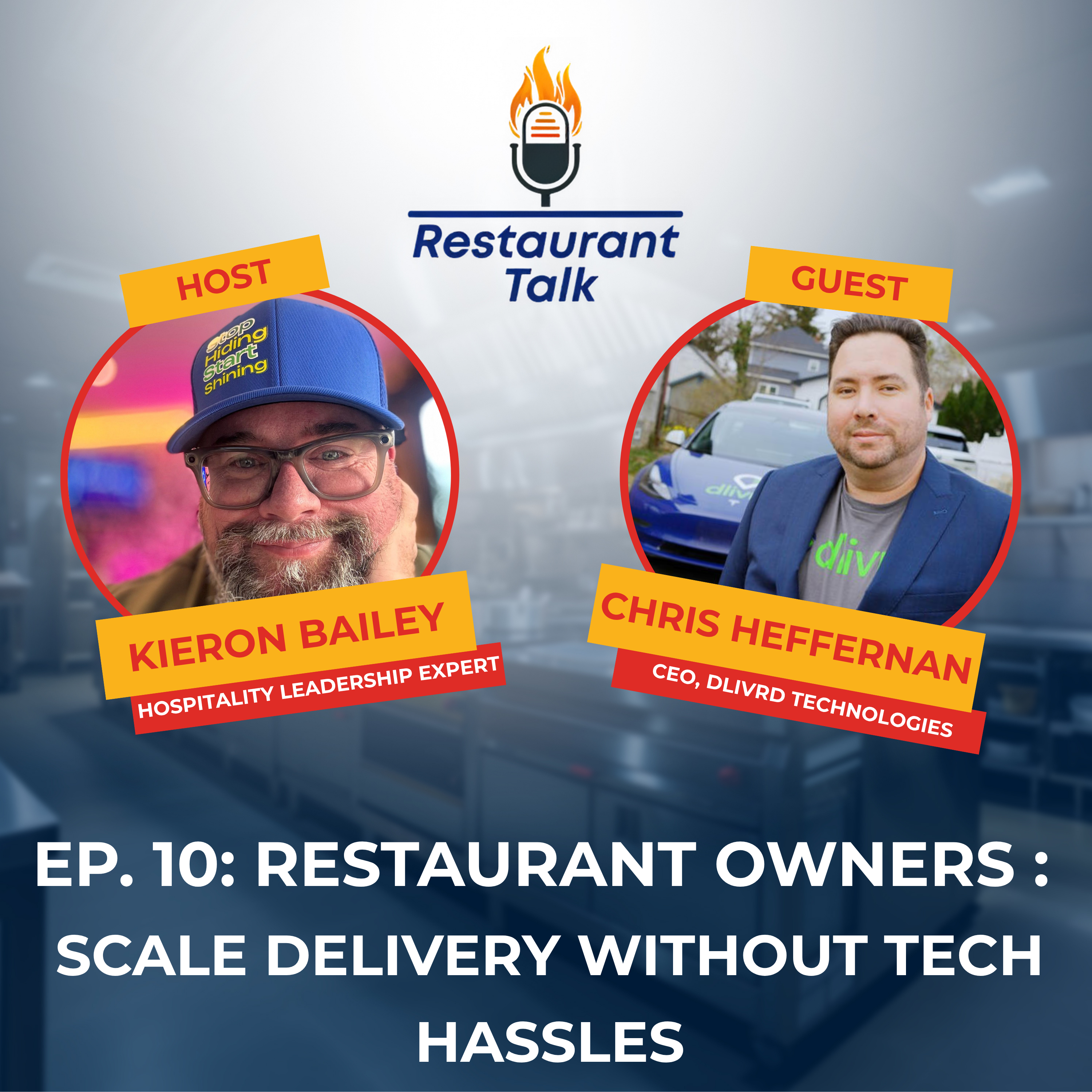
Now today I am joined by my soon to be good friend, Chris Heffernan. Chris, tell the nice people who you are, where you're from and let's get stuck in.
[00:00:52] Speaker C: Yeah, let's do this. I am from Philadelphia, Pennsylvania and I am the CEO of Deliver Technologies. Last Mile Technology driven solution companies empowering brands to power their off premise delivery and takeaway model.
[00:01:08] Speaker B: Dang, you've said that a few times, eh?
[00:01:10] Speaker C: Second time, that little pitch.
[00:01:12] Speaker B: Okay, yeah, absolutely. I like it, I like it. So let's talk about Delivered. You know, I was doing some research on what you guys do and I kind of, I'm obviously based in the uk. You're over in the us. Are you making a mission over. Are you going to be finding your way over to English waters soon or.
[00:01:28] Speaker C: Yeah. We had just purchased a UK based delivery app, it's called Van Use. We purchased them on the 31st of August, so we're integrating their tech stack into ours and we should be operating over there in Dublin and in London by the end of September.
[00:01:46] Speaker B: Ah, amazing. That's exciting. It is cool.
[00:01:50] Speaker C: I'm an international businessman.
[00:01:52] Speaker B: I mean that feels good, doesn't it? Put that on business card, right?
[00:01:56] Speaker C: I got it tattooed on my arm.
An invisible ink because I don't, I don't like tattoos. It's there, you know, if you look, if you look.
[00:02:02] Speaker B: Yeah, let's not go crazy about it. No one wants to be like too ostentatious, kind of showing off, you know, tell your mum, celebrate with your mum, do a little dance and all that kind of thing. It feels nice. It's good, yeah, perfect. So operating in the UK from September, nice. That feels kind of a good thing to do. London, obviously is, is. It's an incredible city, Dublin. I've had some crazy times in Dublin, I'll be honest with you. Um, are you going to be coming over and spending a bit of time over here, seeing how it goes, kind of make pressing the flesh?
[00:02:29] Speaker C: Yeah, yeah. That's the goal is in, in like the end of October to, to get some time, to get some time over There, ironically, my travel schedule is already booked through like October 22nd. So that's basically the soonest I could get over there and, you know, do some paperwork and cross some T's, get a lay to the land, meet some of the drivers that use the app, meet some of the team that came with the, with the acquisition and really try and make it a part of the network even though it' so far away from our home base.
[00:02:58] Speaker B: Nice. So I guess that actually opens up a really interesting question to me. Kind of you, you, you've take on board a whole load of different kind of tech solutions. You bought within the delivered kind of platform. What is it about? What is it about a business and a brand that kind of looks, makes you look at it and go, yeah, we want that within our business. We want to be able to kind of add value to that.
[00:03:18] Speaker C: Yeah. And it all started with just the simple proposition. We just started powering delivery for brands. So, hey, you need a delivery driver, we can do that, right? And we did that. You know, brands would be, hey, we need this fur, we need delivery tracking or we need the ability to put these orders in and we need, you know, we want this or we want that. And we would, you know, make changes and adapt. And then as we started building this, you know, I guess brand trust or brand loyalty, they would be like, well, what should we do about online ordering? What should we do about reputation management? What should we do about all these different pieces of the off premise journey that they were combining other tech stacks too. And we started giving advice on like, oh, you should work with this partner. But then it's like, well, we just lost revenue to that partner. Or we'd refer that partner and then they wouldn't maybe do great. Or we would refer the partner and then they would send the deliveries to our competitor. So it became like, all right, like we have the right team in place, we have customer service, we have sales, you know, we have account management.
Why not just start roping these things all together in one world where they're all connected so you don't need to sign up for five or six different SaaS. You can sign up for one and get one bill and have one account rep and have all these things that talk together and work nicely and bring it all together. And that's what we started building and what we're starting to see the fruits of building here now.
[00:04:42] Speaker B: I mean, I love that. I mean, so a little bit about me, I started out as an operator back in the day, spent sort of 20, 20 odd years in, realized I got the needs of a 90 year old now, so doing that just doesn't work for me anymore.
But when I talk to operators today, we talk about kind of the challenges with tech is how do you make sure that it's all talking to each other effectively, how do you make sure that it all kind of works together and actually helps you to leverage all of, the, kind of the best bits from all of that tech? Well, building a single tech stack is a really good starting point.
Is that kind of something that you felt kind of feedback through from operators that actually having all of that in one place makes their life easier?
[00:05:24] Speaker C: Yeah, it's because they all talk so they don't have to take. You know, take reputation management for example, like getting customer feedback after, after, after a catering delivery, after a takeaway, after a regular delivery. If that's handled by a third party system. You get your online order from one place and you can see the order details there. But you want to find out how, like how well the customer enjoyed the meal or if there was problems with the packaging, then you need to go to the other software that you use that sent them the message or maybe even past that, you have to take that customer's info, put it into the other software, send the request for the feedback, then go back to that other software later and check it where in this ecosystem orders delivered, a delay is set 15, 30, 60 minutes, that triggers the request for feedback. Feedback goes, if feedback is left, it's sent right back into that same order management system. So you've done everything automated from one place as opposed to jumping between two screens three different times just to find out that the person really liked the french fries because they use this fry oil saver.
[00:06:29] Speaker B: I mean I love that, I absolutely love that. And genuinely I think, I think back to my days as an operator, even just for that kind of. So for customer response stuff, you know, you're dealing with feedback, some of it's good, some of it's not so good.
And that can become incredibly challenging. And you end up going through two or three different systems to find information. Whereas actually as you say that this triggers this, this triggers this, this triggers this. And all of a sudden customer feels seen, customer feels heard, customer feels understood. So three core things that we as people are looking for in life, I think, and they suddenly they feel great about life. That makes perfect sense. So kind of what, what brands are you working with? Are you able to talk about the brand you're working with? I'm assuming you are to Be fair, who you're working with. You kind of big brands, small brands. Where you at?
[00:07:14] Speaker C: Yeah, no, we're. We're here for everybody. So we work with everybody from the mom and pops. The first restaurant we got started with back in like 2018 in Northeast Philadelphia, it's a restaurant called Sweet Lucy's Barbecue.
Great, great Southern barbecue in a northeastern city.
One location, they do a crazy amount of deliveries, especially catering. We've been working with them forever. But then we also work with enterprise brands like Bojangles. It's a fried chicken place. They're all over the US like 900 locations. Don't quote me. That might be wrong. I don't want to get sued by their attorney. But a ton of locations and we just started powering their college game day deliveries to tailgate parking lots for, you know, for American football. So it could be that one location, you know, barbecue, specialty brand, all the way up to, you know, the master, you know, franchise model, business enterprises as well. And everything in between.
The bread and butter. Bread and butter is really those quick service restaurants.
Think of like in the States, like qdobas, Viva Chickens. Cozy dig, like comfort food in a bowl. Quick. It works really well for delivery. It works really well for catering. And that's where we find like the sweet spot for the operators that need the. The services that we provide.
[00:08:34] Speaker B: I love that. I think it's, again, I'm lucky I get to spend my days talking to operators.
And a lot of the smaller ones sometimes feel like that they are kind of excluded from having options of this great tech because they feel like some of the big brands aren't that interested in them because, well, they're not a big business and they're not a great revenue stream in the long stream. But you just never know, do you? And as you say, kind of, I mean, Lucy's Barbecue sounds like an absolute belter. It feels like she's nailed what she does and smashes it. That's a really interesting thing you talk about as well, the kind of supporting things like tailgate parties. Because tailgate parties are a very. And this is me getting digressing now, so work with me. Tailgate parties are a very kind of uniquely American process. You know, kind of if I go to the football slash soccer in this country, I kind of, I rock up to the game. I maybe get a bag of chips or a hot dog on the way in, and then I'm going to go and watch the game, shout as loudly as I can do and inspire. And by God, Chris, I can Shout, but. And then I'm going to go home and that's it. But for you guys, you're really stretching it out there. So how are you able to help those people in that situation? What, what are you able to do for them, to support them, to, to make that great experience for their customers?
[00:09:47] Speaker C: Yeah, I mean there is mostly on the last mile piece of it, getting the food from the restaurant to the tailgate. Right. So for us, American football, tailgate lots open five hours before kickoff. So and if it's a one o' clock game, cars are lining up at like one in the morning, like, you know, if it's a one in the afternoon game, one in the morning, cars are lining up, at least in Philadelphia, outside the stadium, like waiting to, waiting to get in. We had our home opener last night, it was 8 o', clock, which is why I'm working from home today, because it went until you know, midnight and the cars started lining up at 6 o' clock the night before to like make sure they got their spots in the parking lot to set up for their tailgates. So what we really power in this particular thing is dealing with the madness of getting the food from a restaurant to a parking lot for a game day experience and then into the parking lot where there's tens of thousands of people tailgating to the tailgate that is being produced by this experiential marketing event and setting up the Bojangles fried chicken for the, you know, football fans.
[00:10:54] Speaker B: That's just crazy. As, I mean, as somebody who's never experienced that, I kind of, I listen to that and I think, wow, that's the idea of getting, getting in your car at 1:00 clock in the morning thinking, right, I'm getting my spot. I'm like, no, I'm having a nap, I'm having a good night's sleep and I'm going to come prepared, ready to make some noise.
[00:11:12] Speaker C: Once you park in the spot, you park in the spot, you take your nap, you wake up, you drink, you go to the game, go back, traffic so bad, you nap again and then you drive home.
[00:11:21] Speaker B: I mean, already I feel like I want to come to Philadelphia and enjoy a bit of tailgating. I'll be honest. I mean, I'm a raging vegetarian, but I cannot find some joy in it somewhere. You know what I mean? Find some joy in it somewhere.
So that's a real cross section of kind of things you're looking at. And I think I was going through your website and I was thinking about kind of the thing that really kind of struck me was those four pillars that you kind of, that you work to, and I love that as any business and kind of experience first was the top of the list. Talk to me about kind of how you're doing that. How are you driving engagement, how you're driving loyalty for those businesses, whether it be for mom and pop or whether it be for those huge brands.
[00:11:58] Speaker C: Yeah. And what we're kind of seeing as an industry as a whole, right. As a tech industry and even as like a restaurant industry, customers crave experiences, right. For us in the tech world, you can get online delivery and catering and you know, mat order management, all these things from a lot of different purveyors, right. We bundle it up nice into an ecosystem. As a consumer from the restaurant world, you can get a burger from pretty much anywhere. Customers are craving that experience. Right. So we kind of do it by prioritizing like our workforce interactions. And what that means is how we interact with our delivery drivers, how we interact with our workers and employees.
For us it's all about creating, creating a good workforce. So we meet with delivery drivers, we pick different cities and we go out and we go to like a Dave and Buster's. It's like a big arcade thing here in the States. I don't know, it's very soon Dave.
[00:12:51] Speaker B: And Busters, I was in video games.
[00:12:54] Speaker C: You shoot, you know, shoot electronic guns or whatever.
But we, we invite the drivers, their family, they get play tokens, they can go play the games, they can get some food, we have a little buffet, they can get some drinks, like whatever they want, meet the team, ask questions, engage with us. Because happy drivers make happy deliveries, right. So you know, we put that very much forefront, single touch base, right? So like making sure that you take ownership and show you care. So if a client reaches out, it's not, oh, you got to talk with my colleague Pam, let me transfer you to her. Or someone will email or call you back like no one touch, you know, solve that problem, get it done and drive deeper engagement. The same way that we meet with the drivers, we meet with the restaurants, we publish a lot of content on our social media on tips and tricks on how to drive your off premise business, how to get more takeaway, how to operate a better delivery model.
And then you know, we also just get into general like food stuff as well because we're a food tech company and we all love food. We have a full kitchen in our office so like we can cook stuff for the office and you know, we'll have Competitions from time to time in the kitchen, like, queso battles. Different. Like, different fun stuff like that.
[00:14:06] Speaker B: I mean, that sounds very cool. And I love what I'm hearing A lot of in there is kind of. There's a lot of accountability, and it's about people taking. Taking responsibility and accountability for making sure that guest experience is on point. And if a guest has a question, if has some issues, then as you say, rather than passing it across, I'm dealing with that situation. And I love that there is. There's nothing worse as a kind of. As a customer anywhere when you've just got a simple situ. Simple issue that can be resolved, but somebody just feels the need to pass you across to the next person. You're like, dude, just get it fixed for me, please, in this moment. And I walk away feeling happy about life. That's what we're looking for, right?
[00:14:44] Speaker C: That's the biggest thing in, you know, in the first of the. The experience. First things that sticks out to me is like, the take ownership and show you care. Right? Like, and that. That applies to any business, any model. Like, anything you do ever own that issue and. And pretend, maybe pretend well, to have some empathy around it and just try and just try and solve it for the customer there. Because in, you know, in the. In the restaurant world, if someone's, you know, their chips were soggy, okay, here's a coupon or a gift card, or here's another. Here's more chips. Like, fresh chips, as opposed to, like, oh, let me go get the manager. Like, which one would you prefer? As a consumer? Like, no, I just want the other chips. I don't want to talk to another person. Fix it for me. Like, hey, I understand. I hate soggy chips, too. Here you go.
[00:15:28] Speaker B: Yeah, I'll fix that. And maybe you ordered a small.
[00:15:30] Speaker C: I got you a large.
[00:15:31] Speaker B: You know, exactly that. And maybe at some point, the manager's gonna wonder why and say, oh, you had an issue, and we fixed that for you. Is everything cool now? Yeah, because that's. That for me, is the big one now. Because what's that showing is actually we're communicating and the manager's taking responsibility for the whole shift.
It was one of the rules back in the day in my restaurant life. Chris was like, if there was an issue in any of the restaurants, the manager must have spoken to that guest. And it doesn't mean they would have solved the problem. It just means they must have gone and touched that table, had a conversation, and just made sure that that customer feels comfortable, that actually Nothing's been hidden that actually we've just solved this problem and we're all happy we fixed it. Any other thing we can do for you, Boom, Happy days.
[00:16:12] Speaker C: Yeah. And that's what's going to drive brand loyalty. Like that person's not going to remember the soggy chips. They're going to remember the great exc experience and that's what's going to drive them back. Otherwise they're going to remember the soggy chips and they might go somewhere else.
[00:16:26] Speaker B: And, and then they might start talking about it on social media and because we know that's the world, the way of the world now. I mean I had a bad experience at a dentist last week and I spent 35 minutes on a Tik Tok live just moaning about it really like that was it like. But it wasn't even the dentist that was a bad experience. It was the customer experience part of it. It was the way that they dealt with me and I was just like, it affected. Infuriated me to the point that I actually told her in the moment and the girl was just like, I don't like your attitude. And I was like, you're not supposed to like my attitude. Right now I'm upset.
Kind of it. Kind of it.
[00:16:58] Speaker A: Every day, fryer oil drains your profits. Dump, buy, repeat, Frylo ends the cycle. This small device sits in your fryer, doubles oil life and cuts costs by up to 50%.
The result, crispier, lighter, less greasy food.
No risk, nothing up front, no ongoing maintenance costs. Visit save fry oil and stop deep frying your profits.
[00:17:28] Speaker B: So nice. I love that. And then the kind of. The next part was, I've always kind of said that when I was, when I was an operator I used to work a lot on instinct and I used to work a lot on my gut. And then I had a moment and a moment of epiphany where I realized the level of data that we've got access to to as operators certainly now if you pair that data with gut instinct, oh, what a, what a. Just what an opportunity to really nail it. So you guys are working hard around kind of being smart and nimble on those kind of data driven insights. How are you tapping into that?
[00:18:01] Speaker C: Yeah, no, it's a great call too. And fun fact here, there's a little Easter egg in the smart and nimble. Through our deliver journey, we acquired a delivery service in the States called Nimble.
So it kind of made its way like into our pillars because it was a small scrappy team as well that it, that it did really well in getting customers and fit kind of our, like our vibe, our model. So when we were redoing our, you know, our four pillars, they, it made it in, it made it in his little Easter egg. But that's really cool.
[00:18:29] Speaker B: That makes them feel special.
[00:18:31] Speaker C: Yeah, yeah. Just, you know, another way to really like put that experience first. Right. And drive that, drive that workforce engagement. But no, data driven insights are huge, right? And same you could, you can use gut feeling and pair it with data, but there's nothing like being able to say let's try it and track it, right? Like hey, you have an idea, awesome, let's, let's try it. We'll see what happens. And then you monitor those results, right? So and it could be across anything and with all the data tools and you know, and all the different softwares that are out there have different reports and it's really hard to look at all these reports. But now in the age of AI too, like you can fire up a free ChatGPT account, download your POS report, throw it in and be like, find 5 trends in my POS report that I might not be seeing and like let it kick out. Right? But there's so many different things you could look at from. And let's focus on like the, the takeaway and delivery stuff. Prep times. Prep times are a huge, huge lackluster thing in data driven insights, right? People assume they know how long it takes to make their food. They know how long it takes in an ideal setting at 3 o', clock, pre lunch or pre rush. I'm sorry, but they don't know that it takes ten minutes longer at the five o' clock time. And your system can enhance that. Your system can work through knowing these different time things and it's going to make a better experience for your customers that are getting these off premise orders. But my gut says it takes 10 minutes. So it takes 10 minutes. Well, it doesn't, you know, so that's just one example of data driven insights for a brand and for us, we use it for setting pickup times, doing delivery. Like we have all kinds of different reports that we run, pick up on time, delivery on time, customer satisfaction, like all of our key data points that we run through and really use that to make our decisions on what product we're going to do, what KPI. We're going to focus on how we're going to service this customer better.
[00:20:27] Speaker B: Love that, I think. And again, I'll trip back to being an operator and being told by an executive chef once how long it takes to prep a specific dish and what kit you need to be able to do that? And I just remember asking the question, so when you built that, when you did this exercise, did you do that on a Saturday night at 7:30 or did you do that in a prep kitchen at about 3 o' clock in the afternoon, once you'd had your afternoon brew and you were feeling pretty relaxed and you were ready to pop? And he went, well, it was two o', clock, but still, yeah, that's roughly when we did it. So having that kind of, having that knowledge is great, but having the real time knowledge and just having access to, honestly, it blows me away. How much data is available to folks right now, even to small operators? Chatting to a guy runs a bagel business in Nottingham and he doesn't have his own WI fi in his shop. And I said to him, why don't you do that? And he's like, well, it's just a cost, isn't it? I was like, it's really not. It's a huge investment.
I was like, think about the data that you will gain from people who are trapping in and connecting with your WI fi and then think about how you can connect with them further down the line. And he was like, I hadn't really considered that. I was like, maybe just go and get some good WI fi. I don't know. I mean, I was miffed because I was trying to have a video call and connect to the WI fi.
[00:21:46] Speaker C: Really? You were just secretly pissed that you couldn't do, you couldn't work from this establishment for free?
[00:21:50] Speaker B: Chris I'm fundamentally a selfish man. You know, I mean, I'm what I am. I kind of.
I like the spot. I just don't like the fact if I'm going to do a video call, I've got to hook up onto his neighbor's WI fi and hope to God that it stays. Stays the course.
It didn't stay the course.
It just doesn't make any sense. So that taps in then for me into that kind of, that next one that visionary partnerships. I love this. I think I'm really careful about who I connect with. I'm really careful about who I want to do business with. You know, I think I'm very lucky in the fact that personally, I'm a man who kind of knows some people. So a lot of people come to me and say, could you recommend me to do this? And I'm like, I don't know if your kit is amazing. I'm only going to do that if what you do is top of top draw, otherwise my reputation starts to get attached to maybe average stuff, and that's fine. Like this people do average and they do well. It works for them. So for you, you're thinking about kind of how do you pick up these partnerships and how do you make them more effective? So I guess that taps back to kind of when you're buying these businesses and you're getting on board with businesses, is it really important to you that they're kind of. They're as close to best in class that they can possibly be and that they're going to contribute huge value to your customers moving forward?
[00:23:02] Speaker C: Yeah. And a lot of it, you know, this, this transcends. This pillar, transcends so many different interactions. It transcends our partnership with the delivery drivers. Right. Not every driver is a good fit for our platform. Right. It'd be perfect on a doing a just eat order, you know, like dropping off the one burger to one person, like leaving it at the front door and walking away. So not every driver is the right driver. Not every restaurant that we work with or brand is the right brand. Right. We want. This is a partnership. Our success is their success. Their success is our.
If you see us as a simple vendor or like a line on a. On a balance sheet, like, we, we might not be the best fit. Because you're looking for the dollars and cents in the transaction, not the dollars and cents in the growth and the downstream that you're going to save on credits and adjustments and lost customers and things like that. And then when it comes to the strategic acquisitions. Yeah. I mean, we look for this as well. The number one thing we look for as we're going through this is for me, like, could I have a pint with this person? Right. And if the answer is instantly no, then I'm not sure that it's even worth going down the line to figure out the rest of the business model. Because if I couldn't think that I could sit with you at a pub for an hour and have a beer, which I enjoy, that you like, how could I work 40 to 60 hours a week with you building something that I'm supposed to be passionate about and it's supposed to help people, and I couldn't even do one of the happiest things that I love the most.
[00:24:31] Speaker B: Oh, man, I love that. That. And I'll tell you why I love it, because that taps into that operator mindset so neatly.
I was like 22, and I was. I was a trainer manager for a Pub company. And I said to my area manager, I'm like, I'm young, like I'm good. Like, what?
This is a risk. And you know, Kieran, I just want to know one thing, dude. Like, when you meet these people and when you've trained these people, do you want to sit and have a beer or a brew with them? And if you can't sit and have a beer and a brew with them, then why would your customers? And I was like, okay, well that was easier. You know, just like I'm worrying about how I'm going to teach these people how to do their job properly. And he's like, are you just gonna, are people going to be able to connect with them in these moments? And if the answer's no, then they're probably not for us. And that's, that's it. And I love that, that actually, you know, sometimes you hear folks talking about kind of the tech world and the operator world and they think there's a disconnect. But clearly, very clearly in the world we've delivered, there's a real kind of, and I love to use the word but synergy and the way that kind of operators things and kind of you guys are thinking and I just, when we finish, I'm going to go punch myself in the face for saying the word synergy. Just so.
[00:25:36] Speaker C: I appreciate that because it's one of.
[00:25:37] Speaker B: My, like, it's unnecessary.
[00:25:40] Speaker C: Like, I hate.
I use vibe instead of culture. I hate the word culture. I think it's a way to hide like a really toxic workplace under the guise of like, we have a ping pong table. That's what culture is, right? Like, yeah, yeah, we make you work till 9pm at night, but hey guys, there's snackables in the fridge. Like culture.
Yeah, we go for vibe, energy and like energy you can't fake. Right? A ping pong table is, is very easily a cheat code in life.
[00:26:07] Speaker B: It really is. And, and to be fair, who wants to play ping Pong at 9 o' clock after you've done a full shift? I'll be honest with you, I'm not having it, Chris. I'm not. You know, if there's, if there's a beer tap on the end as well, that's also an indicator for me. If, if you need beer to get through the day, then maybe I've got questions about your culture as well. To be fair, I don't know if.
[00:26:24] Speaker C: We should throw any shots at that.
[00:26:26] Speaker B: I mean, you got a beer tap? Have you got a beer tap?
[00:26:29] Speaker C: No, we have a beer fridge, we have a water tap that you can infuse flavors into. And you can do sparkling, ambient or cold. And then you can add caffeine, you can add Immuno boost and something else. So it's a, it's a fun machine that you can like spice up your water, but you can also put vodka in that if you, you want.
[00:26:48] Speaker B: I mean, fair. It's good to have choices, but that sounds quite right. That's a fantastic.
[00:26:51] Speaker C: What's life without a little whimsy?
[00:26:53] Speaker B: I mean, realistically. Yes, I'm with you on that one. I am with you.
I love that. That works. And then finally, I guess that final one is the results that matter. And I think for me, when I was thinking about this, when I was thinking about that kind of the idea of long term value. And again, that's, that's so important to me. And I think, and it seems like it's important to you that actually this is a relationship for, not just for today, but this is a relationship for tomorrow, next year, and maybe a decade down the line.
Does that, does that. Is that how you guys are operating?
[00:27:23] Speaker C: Yeah, it's, it's, it's built for the long term. Right. Like doing something for a short time doesn't matter. Right. Like having a good Wednesday doesn't mean that the whole week was great. And past that, like results that matter means also, like we're looking at the right metrics in the delivery space. Right. Which is, which is the footer, the foundation of what got our business started. You'll look at brands like delivery brands or delivery tech companies, they'll say, we delivered 99.8% of the time. And as a consumer, as a, as a potential client, you're like, oh, wow, 99.8% of the time, only 0.2%.
That's great. But what does that mean? That means that you pick something up maybe on time, maybe not, and delivered it maybe in full, maybe correct, or maybe not 99.8% of the time. So that's a fluffy metric for us. We focus on, we call it success rate. And success rate is not just did we pick it up and drop it off? Did we pick it up on time? Did we drop it off on time? Did we supply order tracking throughout that whole journey? Was there a really good proof of delivery photo that shows where the package was left, validated by a GPS pin that it was left at the right place? And did we communicate that to the customer? Did the driver do any other deliveries while he was just doing this one. So we look at seven different metrics that create a successful delivery and it's not 99.8%, it's about 70%. So seven out of 10 times we get this 100%. Right.
So you know, you could look at fluffy metrics as a business and feel good is like the fake metric fairy. Patch your head and says 99.8%. We did great. But only seven out of those 10 orders were actually to your customer's expectation. So looking at the right metrics that matter make the difference in building that long term sustainable relationship.
[00:29:11] Speaker B: So how are you changing? Because realistically, most people, they're going to talk to suppliers and operators who are going to give those fluffy metrics. And there's a comfort to those fluffy metrics.
Maybe I don't interrogate it too deeply and I just accept the fact that it's going to be 98% of the time we're going to be on success. And that feels good to hear in the moment. How are you changing that perception of people who have. When you say to them, right, we're going to be honest with you, we're at like 70, 70 odd percent of the time, which doesn't sound as good when I talk. When you look at the big highlight headlines, how are you changing that perception that people look at that and go, well, actually, okay, that's actually better. And that already when you look at the detail, I feel much more comfortable that we're getting the stronger and better result consistently.
[00:29:55] Speaker C: Yeah. So we, the other, the other metric, that other like call successful deliveries, that 99.8% that everybody else calls a successful order, we just call that a filled order.
So when we're talking with a brand, yeah, we'll be able to fill 99.8% of your orders that you send our way.
But like, let us tell you about what a successful order is. Has anybody told you what their success order is? Oh, well, they say 98 whatever percent. No, no, no. That's their fill. That's how many they're gonna successfully ingest in their system and deliver for you. But how many of those have accurate API tracking links for your customers? How many of those have valid proof of delivery photos? We don't know. They didn't tell us. Well, yeah, they didn't tell you because it probably sucks and ours kind of sucks. But it's probably better than theirs because we're dealing with so many different variables. Like we have the person that ordered it, we have to rely on them to give the right information. The person that made the order to put the right stuff in the order and a delivery driver who's an independent contractor to put that all together while whittling in. You know, technology mishaps that can happen, right? Like GPS bin errors or tracking issues or the person has an iPhone3, you know, so like, it doesn't send location stuff and doesn't have a camera. Maybe they're still using a BlackBerry. I don't know. So you whittle that in. In human nature and like, yeah, seven out of ten times actually seems really strong when you think about all those things combined already.
[00:31:13] Speaker B: I feel much more confident. I already feel much more comfortable that, that those seven out of ten are going to be much happier than that. 90% of be 90 odd percent of people who have got the fluffy number.
I'm not into fluff. It doesn't work for me. Oh, that sounded weird. That's not.
Let's get past that.
[00:31:31] Speaker C: Yeah. And if you think about a person coming into the store, like, if I'm like, do you think 98.8% of your customers are satisfied every time they walk into your restaurant or your business? Like, and if you say yes, you might be crazy because just like you with the dentist drooling and yelling at somebody. I could only imagine, like, you were one of the, you were one of the. This one of the 70% that weren't happy on a successful delivery. Right. It happens. And we need to realize that as business owners, as brands, as customers facing people, like, bad customer interactions happen 7 out of 10 times. You can get it right. And that's great. You know, focus on the good.
[00:32:09] Speaker B: I mean, if I could keep my wife happy 70% of the time, I'd be freaking stoked, dude. I'll be honest with you.
[00:32:15] Speaker C: I mean, you definitely write a book.
[00:32:18] Speaker B: I mean, we're doing like 30. We. We celebrated 25 years married this week, so I'm feeling good about that.
[00:32:24] Speaker C: Yeah, you're doing something right.
[00:32:25] Speaker B: Yeah, I think it's. I spend a lot of time away from home, man.
I travel. I travel with work.
[00:32:33] Speaker C: Luckily, she doesn't listen to any of the podcasts, so you're probably sick.
[00:32:36] Speaker B: Well, as it turns out, she actually does.
I didn't think she did, but apparently she is a supportive wife.
[00:32:43] Speaker C: We'll find out whenever this one airs if, if you email me and say, like, I, I'm now sleeping on the couch.
[00:32:49] Speaker B: Yeah. You know, it's kind of spare room time. It is, yeah. One of the reasons why I think we built this little office Was just for those moments in case she kind of just thought, I'm fed up of looking at him. So let's talk about Foodie Friday, man. We're going to move to Foodie Friday because I was going through your LinkedIn and it made me happy. I mean, it is Friday.
Let's talk about it. Because I'm a massive fan of kind of anybody who's creating interesting content that taps into the joy of this industry. And you're definitely doing that. So where does that come from? What drove it, and why are we at it?
[00:33:21] Speaker C: Yeah, no, I always wanted to be an influencer. As a little kid growing up, I saw people talking into phones, and I was just like, I really want to do that that one day.
No, I just.
[00:33:30] Speaker B: I love that I wanted to be a librarian.
[00:33:36] Speaker C: So how that. How'd that work out?
[00:33:37] Speaker B: It's close. Not so well.
[00:33:40] Speaker C: You're in the ballpark.
[00:33:42] Speaker B: I have a lot of books. But anyway. Influencers.
[00:33:45] Speaker C: Influencers, yeah. So no. So I ended up, like, the first Foodie Friday started as, like, just doing some food reviews, right? Like, I was doing food reviews for some of the restaurants that we had worked with, and I was like, this is kind of fun. And then I turned it into, like, a little series and some different variety.
The biggest things that drive me as, like, an entrepreneur and a business owner is travel and food. Traveling places to eat food and eating place, eating things and traveling. So it made sense to kind of start, like, building some content around that. So Foodie Friday came, and then it was Foodie Friday International, talking about the different dishes that I had, different places. So when I was in London, I had fish and chips. So I did a Foodie Friday London fish and chips, right?
I was in Vietnam, and I, you know, I did a cuisine for there. I was in Thailand and I did banh mi. So, you know, I built these things because they say every business has two brands, right? There's the brand of the business that the, you know, the logo, the, you know, the video, the content, all the marketing that you push out should be easily identifiable as that brand's marketing. And then whoever the leader of that brand in has their own presence and their own vibe as well. And I really wanted to steer into that and working with a lot of restaurants. When I was 16, I was a busboy. I washed dishes at restaurants, but I never, like, never got into waiting, which is probably good. Unless it was one of those restaurants where they pay you to be a jerk to customers. Like, I could really get down on that. My Sarcasm. Being from north, the northeast of the US like, is on point. Like, I could tear somebody down in a restaurant where I'm paid to do that, but you would not want me to wait tables with the general, like, general population at, like, a restaurant that didn't want you to be a jerk to them. Yeah, so I've never been in that. I've never been in management. I've never worked in the kitchen. I've never fired, you know, fired an item across the expo counter. Insert jargon here. So I love to eat it and I love to cook it at home, you know, so the foodie Friday that we're in right now is, like, the dishes that I, you know, that I cook when I have people over or I want a happy hour treat or I want, you know, meal prep for the week. So. So it. It's taken a lot of different phases. And the next one will be for. For game day eats, for when we're watching an American football match. Like, what foods I prepare, what I take to. What I take to tailgates. We'll do, like a wing taste test and different fun stuff like that. But just creating a brand as a relatable entrepreneur in the tech space that loves food, loves the travel, and makes me feel like an approachable guy, I guess.
[00:36:10] Speaker B: I mean, it's a lovely way to be able to connect with people, I think, isn't it?
[00:36:13] Speaker C: Oh, yeah. And sometimes I beat myself up about it because I'm like, oh, I didn't get enough likes or comments. Like, I put a lot of energy into this. Is it really worth it? But then I have something like this where you're like, yo, I love that. Right. I don't think you've probably likely not commented on it nor liked it. Right. But you've watched it and been like, that was enjoyable. And from time to time I have, you know, those conversations, and then it's like, you know what? It is worth it. So thank you. Thank you for that.
[00:36:40] Speaker B: Somebody highlighted to me that if 20 people came up to me in a day and said, kieran, your cap and jacket combo today is on point, I'd be stoked. I'd be so happy, and I would be absolutely blown away, and I wouldn't expect it. So why do I expect 20 people to like something that I put up on the Internet? You know, if there are a couple of people go, that's pretty nice. That's a good job. Well done. I'm like, thank you so much. So you're right. The attitude is correct, man. It's like you put it out there for people to enjoy it, people to watch it. And for me I think it's key that it is such a core part of that connection because it's easy as a, as a CEO to kind of, to, to, to be kind of seen as being kind of far away from the core of the brand and the core of the business. But actually you're doing a really nice job there of just showing that you're part of it and, and you're a big smiling face of it. So fair play mate. I'm here for it, to be honest with you. It works.
I got a last question. Well, I've got two questions, but this one's for me, kind of what's, what's the last thing that you ate that just blew you away, that just like made you smile? And, and when you woke up the next day and five days later you were still thinking about it?
[00:37:43] Speaker C: Oof.
I can't. Well, I will change. All right, So I will change. I will expand upon the question a little bit and it'll be more of like where somewhere that I ate at that blew me away and I've talked about for months since eating there. And then I will isolate one dish that will probably destroy you as a non meat eater.
You do you.
So I was, I was traveling, I was in like in and around Europe and, and found myself ending in Copenhagen, up in Denmark. And there is a restaurant up there called Alchemist. It's a Michelin star restaurant. It's huge. It's in an old like marine navy boat warehouse that they turned into this five dining room, like experiential dinner.
It's one of the hardest restaurants to get reservations at. I don't know how I got in. I sent an email and was like, I'm in town for this night only.
I'd love to dine there. Somebody cancels, please let me know. And they were like, hey, table of two canceled. All you.
[00:38:44] Speaker B: Don'T ask for.
[00:38:46] Speaker C: Exactly. Always shoot your shot, right?
52 impressions. Which an impression could be a drink, a bite or a piece of art.
And it took six hours. Our reservation was at 5:45. We left at midnight. You move through five different rooms, you eat all kinds of different things. And the one that stuck out the most was a butterfly. I ate a butterfly.
Like an actual, A freeze dried butterfly with orange and black and little antennas. And you just one bite, butterfly goes in.
[00:39:18] Speaker B: See, you might think as a vegetarian that might outrage me, but actually I'm on board with that because it bothers me that people, kind of people are very deliberate about which animals and insects they think they should eat.
They'll eat a cow, but they won't eat anything else. And I'm like, so I'm with you now. Like, that's nice. And that's an experience. That sounds intense. Insane though. Like five rooms, 52 experience. Oh, mate, that sounds very cool.
[00:39:43] Speaker C: And it was what was really cool about as we're talking about blending tech and experience and food is you get like the whole thing is just insane. But like, like the point of the butterfly ties to a story. Everything has a meaning. And a handful of butterflies or something like that has the same amount of protein as like a chicken breast, something along those lines. So it's talking about, you know, food insecure regions. And it's like, well, how could people get the protein they need in a non traditional way?
And then they, you know, there's one course that's ocean trash and it's like, it looks like you're eating a piece of plastic, but it's really something else. And while you're eating this on the screen, you're in this dome. In the dome above you, you're in a coral reef that is slowly filling with ocean garbage and rubbish. And then eventually an oil spill comes and takes over the whole thing and then it changes to a new scene. And each scene identifies to a set of courses that you eat. So you're moving through this process and the whole thing. So it's blending the technology of art, like audio and visual, the art of the food, the story behind it, everything has some kind of meaning. And the one course is like lamb's brain, which is weird, but you like, you eat this lamb's brain and what's happening on the whole screen, this big dome, you know, is. It's like a pumping heart. But red elicits high stress from people. So typically, if you're. If you walk into a room and the whole room is painted red, your heart rate will rise just because of the reaction to that color. So they have this big. It's all red. It's blood. It's a heart pumping. You're gonna eat a lamb's brain. But then they bring the music volume down real low. So then your body, your rhythm of your heart starts matching the bass from the low beat. So you're experiencing like dopamine highs, but it's not affecting your body the same way that it normally would. So now you're really experiencing like, like the triggers of all these things around you.
Then at one point, we take a tour of the kitchen. And, you know, it's a. It's a French style kitchen, so it's like chefs or guests in the kitchen, and everybody like, stops and turns and looks at you and like, bows and goes right back to whatever they're doing.
But they're using a, A CRM board. Like, it's a trello board with can bands in the tech world. So, like, he's telling me and showing me, like, as soon as your dish fires, it gets moved over here, and then when it gets sent out, it gets moved over here and we keep this whole thing and, and you know, we know when you've been here, what you ate, who took it to you, what time the table hit the expo counter, what time it hit in front of you. Like, there's notes on you. Like, in my email, I said, I've been to these restaurants and these restaurants and like, I'm on this culinary journey and the staff is coming up to me. How was your dinner at D's Fruit Tar last week?
I didn't tell you I was at D's Fruitar. I sent the email that said I was at D Fruitar, and you came and you did that, and that was really, really cool. And here's. And I'm really going on about this, but the. At the end, you go to, like, a little, like, cafe lounge where you get your final aperitif, and the one server going around and touching the tables and getting your final cocktails, unbeknownst to everybody, is the executive chef of the whole thing. Oh.
And he's just like, how, like, how was your experience today? Like, but wasn't like, I'm the executive chef. I'm so and so.
Tell me how it was today. You would think it was just some hourly paid waiter working the lounge area at the end, but one of the dishes throughout the course is a replication. The bowl is. His eye is like his eyeball.
And I'm like. And I'm looking at this guy and I'm looking at my wife, and I'm like, I've seen this guy before. Like, look at his eyes.
And then, like, we're looking, we're back and forth, and we're like, yeah, it's really weird. So then later, you know, the Internet does Internet things. And I'm back at our Airbnb, which was a houseboat in Copenhagen, which was really cool.
And vibes. I.
I see a picture of the. The executive chef, and I'm like, that's the guy that's the guy with the eyeball that was table touching at the end of the night. It was just. It was just ridiculous.
[00:43:49] Speaker B: Dude, that sounds insane.
[00:43:51] Speaker C: Insane.
I mean, I can see why you.
[00:43:54] Speaker B: Can pick one dish from there. I'll be honest.
[00:43:56] Speaker C: That's.
[00:43:56] Speaker B: That's a huge experience, and I love that moment at the end is the exec chef just running around, having a chat, shooting the breeze, and just seeing how people felt.
[00:44:06] Speaker C: Yeah. And I think I made, like, a joke about, like, something, and then later, maybe I shouldn't have made that joke. It's like, chefs are. Chefs are very fragile people.
[00:44:15] Speaker B: Well, I mean, they can be, for sure.
[00:44:18] Speaker C: I will never be able to dine here again.
[00:44:20] Speaker B: To be fair, you know, he's. He's kind of. He's. He's working his little, like, lounge at the end of it without pronouncing himself to the world. He's telling me he's not a fragile soul.
[00:44:30] Speaker C: You might be right.
[00:44:31] Speaker B: I'm in it, mate. That sounds incredible. Wow, I'm so glad you told that story.
It just sounds like a fully kind of sensory experience on every single level.
[00:44:42] Speaker C: Yeah. I'll email you. I made a video about. I'll send it over your way for a sneak.
[00:44:46] Speaker B: Oh, that'd be amazing.
[00:44:47] Speaker C: Yeah. Get a little insight on it.
[00:44:49] Speaker B: Yeah, that would be absolutely amazing if you could give day one, somebody's building a brand, and let's look at it from the tech world. Somebody's building a piece of kit. What's the advice that you're going to give them for day one? What should they be looking at at the start?
[00:45:06] Speaker C: Yeah, this.
This came up. Someone asked me a similar question on. On a much less fun podcast. Right. Like, nothing compared to this.
[00:45:14] Speaker B: But I appreciate you.
[00:45:15] Speaker C: And it was basically the same thing. And out of nowhere, I came up with this, like, good tagline that has kind of stuck with me and, like, kind of worked its way into the DNA of our business. But the same thing would apply to somebody starting up from scratch. And it's automate what you can so you can humanize what's important. Right.
So, like, especially now with all the AI tools and the chat GPT of this and, you know, yada, yada of that. Like, don't waste time doing things that you can automate with a zapier action with a chatgpt prompt. Focus on whatever. Whatever the humanizing part of your brand is. And for most of it's going to be building relationships, finding people that want to have a pint with you, that you. That pass the Pint test. And that would be good partners, right? And, and really, really work on that. Don't spend eight hours a day in spreadsheets or building an MVP product. Like, you know what you think a brand is going to want.
Go talk to the brands, find out what they want.
Automation can't do that and then take that back and build that. So automate what you can so you can humanize what's important.
[00:46:23] Speaker B: I love that as a tagline and I'm going to repeat it. I might give you credit.
I make no promises, you know, I.
[00:46:32] Speaker C: Kind of, I mean, one pound per se.
[00:46:35] Speaker B: I mean, yeah, something along those lines. We'll work out a deal later on, you know what I mean? There's something to it.
That's very cool, man. I like that a lot, you know, so this, this has been a blast and we've talked for a while now, so I'm going to respect your time.
Where, where can people find you? Are you, you're active on LinkedIn?
[00:46:53] Speaker C: Yeah, yeah, I'm active on all the, all the social channels.
So you can find me on LinkedIn, Instagram, Facebook, the Tick Tock, pretty much wherever. Everything's pretty much under the.
[00:47:06] Speaker B: Hang on, hang on, hang on. Can we just take a moment? The Tick Tock.
[00:47:10] Speaker C: The Tick Tock.
[00:47:14] Speaker B: I was greeted on the TikTok last week as Granddad. Somebody greeted me as Granddad. I was like, oh, your granddad was cool. I'm so. That's all I'm saying, I'm going with it. So on the Tick Tock, that's staying with me as well. Thank you.
Connect on LinkedIn and check out what you guys are doing because genuinely, honestly, talking with you has been an absolute blast. And I think really kind of thinking about those four pillars that drive that excellence, it's a beautiful thing. And I think if we're getting this right on a daily basis and that level of honesty and transparency around that, 70% of good experiences, clearly you're good people to be working with, man. Absolutely good people to be working with. Thank you so much for your time. It has been an absolute blast. And I'm gonna drop you an email and when I am in Philadelphia, we will, shall, I shall come and we shall run up those stairs and one of us might make it and one of us might die. I think it might be me that.
[00:48:07] Speaker C: Dies or we die together. It's, you know, I mean, it's the.
[00:48:12] Speaker B: Worst things could happen. Well, I'm sure we're both pretty well insured, so it'll be our wives will be content.
[00:48:17] Speaker C: Yeah, they will be ecstatic.
[00:48:19] Speaker B: They will be content, mate. Thank you so much for your time. It has been an absolute pleasure.
[00:48:24] Speaker C: Likewise. Thank you so much for the chat.
[00:48:26] Speaker B: Perfect. So thank you very much all for tuning in to Restaurant Talk. If you've enjoyed this episode, of course you've enjoyed this episode. It's been fun. It's been engaging. He's been ace. I've been all right. And the world's a fabulous place like. Follow subscribe Wherever you're getting all your podcasts, check out the show notes for info. And again, thanks to our
[email protected] thank you all so much. Have an amazing day.
[00:48:49] Speaker A: Thanks for tuning in to Restaurant Talk. If you enjoyed the episode, please follow, subscribe and share. Thanks to our sponsor, Save Fry Oil. See you next time.