Episode Transcript
[00:00:00] Speaker A: Welcome to Restaurant Talk, the podcast that pulls back the curtain on the industry with real stories and lessons every hospitality leader needs to know.
Sponsored by Save Fry Oil. Fry low cuts fry oil costs and makes food crispier. No power, no chemicals.
Now let's dive into this week's episode.
[00:00:26] Speaker B: Foreign Joanna. Welcome to the Restaurant Talk podcast. I'm super excited to be chatting with you. To me, you guys are like celebrities because I follow you on Instagram. I've, you know, looked at your story and it's super interesting to me, and I personally resonated with it myself. So thank you for coming on today.
[00:00:47] Speaker C: Thank you for having us. I'm super excited.
[00:00:51] Speaker B: So can you tell our listeners a little bit about who you are and what do you do and tell us about your business?
[00:00:57] Speaker C: Jeanette, you go first. Break the ice.
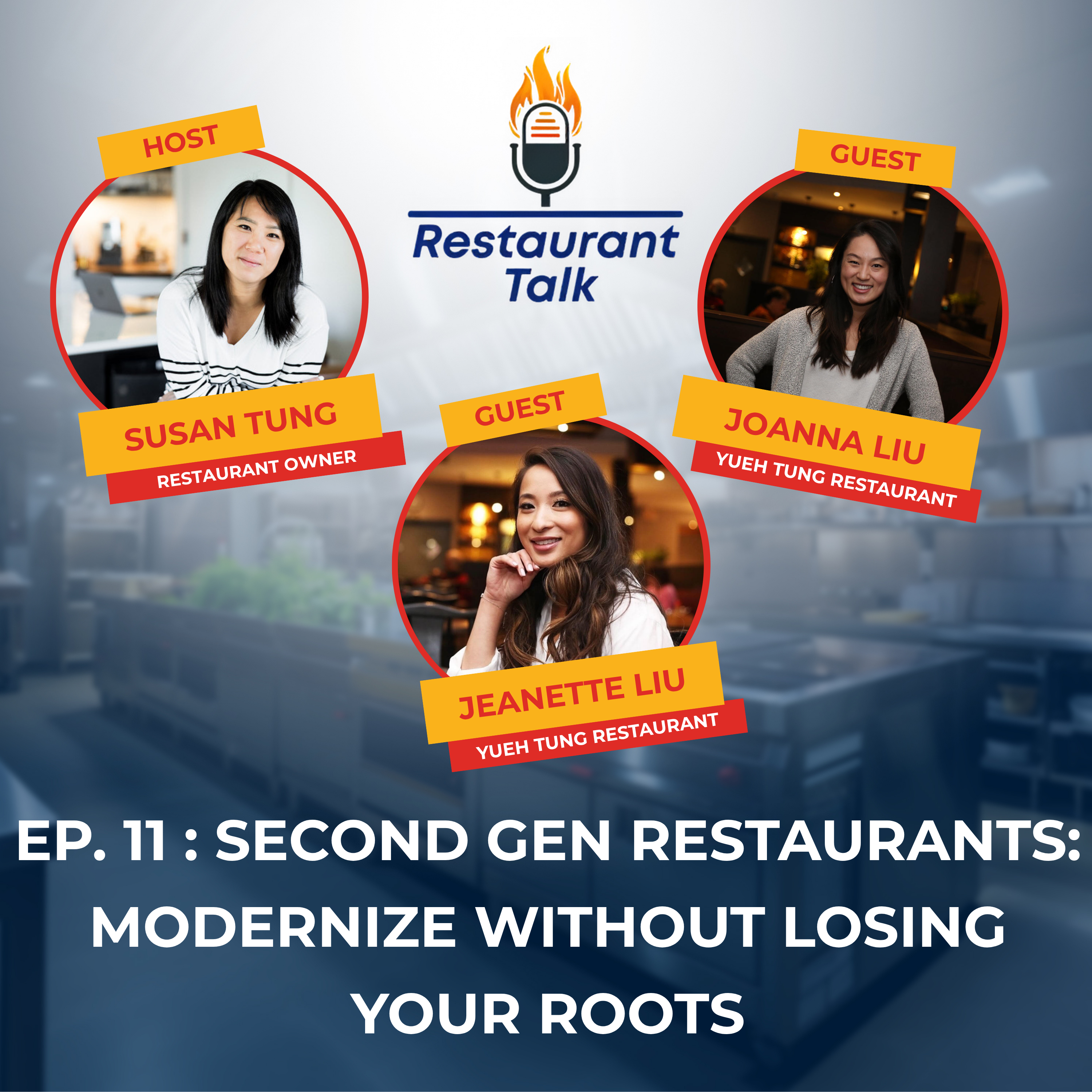
[00:01:01] Speaker D: So we are second generation owners of our family restaurant, Yitong Restaurant, and we own and operate one of the oldest Hakka Chinese restaurants in our original Chinatown in Toronto.
[00:01:18] Speaker B: Okay. For those that don't know where is.
[00:01:20] Speaker D: The original Chinatown, it is Elizabeth street and Dundas. So right by the City Hall.
But originally it was held up by these four pillars.
So it was Guangzhou, Lychee Garden, Nanking, and Tsaiwu. And we just so happened to take over the Guangzhou area or the Guangzhou building. And that's kind of how we became known as this last pillar in our original Chinatown.
[00:01:54] Speaker C: So I guess for people who don't know. Oh, so Elizabeth street was the original Chinatown, and then just because the city needed to expand, they decided to take over Elizabeth street, and then they created it as the new road to City Hall. So a lot of the Chinese community was then moved over elsewhere, and then that's why they set up in Spadina and Broadview later on. But yeah, okay.
[00:02:16] Speaker B: Yeah, I had no idea. That's so cool. There's so much history about, like, Canadian, Chinese and, you know, where people have ended up and just like the movement of people. Right. So that's really fascinating. What are your roles in the business?
[00:02:30] Speaker C: So I am head chef at the restaurant, and my dad begrudgingly gave me all of his recipes when he got sick. But it was a very, very long, tenuous journey. So it took me a very long time to get all the recipes. But yeah, so I just managed the.
[00:02:44] Speaker D: Back of the house, and then I take care of the front of house. That was the role that my mom had.
And so we take care of everything that goes on at the front.
[00:02:55] Speaker B: So growing up, did you have affinity towards those parents based on kind of where you ended up.
[00:03:03] Speaker C: No, I love the outside. And I think I'm pretty much a people person, so I just love having conversations with people.
So I was always at the front of the house with all the women in our family.
And then my father had a heart attack. And we realized that sales were starting to dip a lot just because, like, his flavor palette wasn't there anymore.
So when he got ill and he was unable to work, then I was like, someone needs to be in the kitchen to help manage everything.
Because just like with, I guess, most Asian parents or not all. But there was no legacy planning. So there wasn't an, if I get sick, then who's going to take over? And if I get sick, then should I have recipes written down? Because everything was trade secret. So that's why I was saying it was a very, very difficult journey trying to get all those ingredients and, like, the recipes and everything.
[00:03:48] Speaker B: I feel this in my soul because recently I got my mom to teach me how to make honey garlic ribs. And the measurements that she used were not actual real measurements. They were like, you take this bowl and then you fill it with garlic. And that bowl had like, no actual measurement. It's just like a random bowl.
[00:04:03] Speaker C: Yeah.
[00:04:04] Speaker B: So it's like very painful.
Yeah. So I understand that very much.
Can you take me back to your earliest memories of yet? Tongue.
[00:04:14] Speaker D: You want to take that one, too?
[00:04:16] Speaker C: Me, my earliest memories, I was just thinking this the other day and I didn't realize that I might have ocd. But when I was little, my mom used to.
Well, I used to want to stay by her side all the time. So our hours started from like 9am all the way until like 3am in the morning. And I used to just sit at one of the corner tables and I would take a toothpick and I was just start like digging at all the grooves and like the different tables to get rid of dirt. And SNL would be playing in the background. So I think my earliest memory is just realizing that I didn't have a babysitter and I had to find things to do in the restaurant to keep myself busy. But, yeah, that's my earliest childhood memory.
[00:04:53] Speaker D: I was always at the babysitters with our younger brother.
So I wasn't as attached to the restaurant or my mom, I think, as Joanna was in the early years.
But what I do remember is we were when our parents took over the original spot, it was after a strip club. And so we would have these brass rails that would be on top of the stage.
And I remember we would have parties at night and we would be taking the tickets at the front door and we would just kind of be hobnobbing around with all of these adults that were friends with our parents or like friends of the community.
But yeah, I remember things like that, like kind of being around and, and seeing our parents hosting people all the time and just having these fun parties.
[00:05:46] Speaker C: But it was so funny because we had a big Christmas tree right in front of the large brass rail. But as kids we didn't know.
[00:05:52] Speaker D: Right?
[00:05:52] Speaker C: So we would like twirl around on it and I wonder if our parents even knew what it was. They must have, right?
[00:06:01] Speaker B: That is amazing. Oh my gosh. And it's so stereotypical, like, you know, Asian businesses taking over, like former business spots, but not really, like renovating it. And you just kind of like, make it work. You just like, make you. So similarly, like, my parents had the Chinese restaurant, but before that it was a country western bar. So we had horse saddles for stools.
So it's like you can get chicken fried rice while sitting on this horse saddle at the bar. It was really weird.
[00:06:29] Speaker C: That's so crazy. That's like.
[00:06:32] Speaker D: Like I feel like now when you look back, everyone always wants to change things. They want to make it more bougie, they. They want to do all of these things their business. But there's something about holding the charm from, from before and being able to pay respect to that.
[00:06:49] Speaker B: Totally. I totally agree. Did you guys always think you'd end up in the family business or did, like life pull you back into it? I think you alluded a little bit, but tell us a little bit more about that journey.
[00:06:59] Speaker C: I think maybe more or less, I don't know for me, I think Jeanette as well too.
But I think we always knew that the restaurant would be a part of our lives in some form or another.
So we did, like a different degrees and just, I think just our personalities wanted us to come back to the restaurant. So it wasn't so much because our parents wanted us to come back. I think it was just because the idea and the notion of losing essentially a family member, which is our business, would be very, very harmful for our family.
Um, so I don't know that that's why I think I've always been drawn to the restaurant.
[00:07:34] Speaker D: It really pisses me off when people say things like, oh, you guys are taking over.
Your parents are so lucky and you guys are, you know, brave. You're giving up everything. But it's not, it's not something that we honestly look at as a burden to us.
I think that seems to be the consensus. Like, people think that because we've taken on carrying on the restaurant, that it is a burden, but it's not.
Truly. It is a privilege for us to kind of be able to carry forward what our parents have built. But I've always felt like eventually, even when I was young, that I would be called back into the restaurant in some sort of way.
And I'm happy about it. Like, I'm proud. I'm glad to be working with my sister. If we weren't at the restaurant, we wouldn't really, I don't think, get the chance to see each other as much as we do now and to feel our parents in, like, in the space like that. That's really important for us, too.
[00:08:41] Speaker C: Or for me.
[00:08:42] Speaker D: Yeah.
[00:08:43] Speaker B: What about the other siblings? Where are they at? They didn't want to have anything to do with it.
[00:08:47] Speaker D: They're smarter than we are.
[00:08:48] Speaker C: Yeah, I know.
[00:08:49] Speaker D: They're all doing different things.
Our brother's out in Vancouver, so he's a television wr and he just recently published a book.
And then our other kids give it a plug.
[00:09:00] Speaker B: Tell us what it's called.
[00:09:01] Speaker D: Oh, it is called he's so Possessed With Me.
[00:09:05] Speaker C: It's really, really good.
[00:09:06] Speaker D: It's signed by Little. Little Brown.
But yes, he's so honestly humble about it, too. So nobody hears about it unless we actually talk about it for him.
[00:09:17] Speaker C: He's very talented. So our brother is gay and the novel is essentially about, like, teen love, but teen love in the eyes of. Oh, I have it.
[00:09:24] Speaker D: Teen.
[00:09:25] Speaker C: Teen love in the eyes.
A queer kid. And how difficult it is. But so anyway, so there's two characters, they're best friends, and then one of them falls in love with somebody, but then it's a toxic relationship. And then we find out that it's actually a demon. So now his demon, this demon, is trying to take over the life of his best friend. But yeah, that's. Sorry, that's the plug.
[00:09:46] Speaker B: Wow.
[00:09:47] Speaker C: Love it.
[00:09:47] Speaker B: Good job, brother.
[00:09:49] Speaker C: And then.
[00:09:49] Speaker B: Is there there's two more siblings? Because there's five.
[00:09:51] Speaker C: Yes. And then Emmy works for Toronto Public Library, and so she does, like, all the stats and stuff like that for them and community outreach. And then we have our sister Tracy, who is an optometrist and she's located out in Stouffville right now. But yeah.
[00:10:05] Speaker B: Okay. So just naturally, like, you guys, all the two of you fell back into the business. It was, like, destined to be out of the five. It was the two of you?
[00:10:14] Speaker C: Yeah.
[00:10:14] Speaker D: And Joanna didn't want us to work together.
[00:10:16] Speaker C: Yes. Sorry, Susan. I completely forgot. I think as we age, I see it now as a privilege, is what Jeanette was saying. But when I was younger, I saw it as a. What was the word? A burden. A huge hu.
But that was a burden that we had placed on ourselves. Not so much because our parents wanted to. I think it's that. That, like, you know, Asian guilt.
[00:10:36] Speaker D: For me, I would see our mom, and I would see the way that she would interact with people. I would see how people would gravitate towards her.
And I always saw my mom as like, a very strong, independent businesswoman. So when I saw that growing up, I wanted to do the same thing as her. I wanted to kind of mimic that. So I don't think there was ever a moment where I was like. I didn't think of it really as a burden. I really just. My mom is my inspiration. So when. When I saw her doing that, I've always kind of just wanted to. To be like her.
[00:11:16] Speaker B: That's awesome. That's very sweet.
Let's talk a little bit about the. The food scene in Toronto and kind of the evolution of your business.
You know, so much has changed in this industry.
How have you guys stayed relevant but, like, keeping with your roots?
[00:11:32] Speaker C: Definitely, a lot through media, so social media. And that's all Jeanette, essentially, like, we're having this conversation with you because of the outreach that she's done on social media.
I think in terms of food, we've kept it predominantly the same, maybe just methods a little bit more differently, so that it runs more efficiently and a lot more organized than what it used to be beforehand. But I think the food has the same soul that my mom and my dad had from before. And the difference is now just the outreach that we have in media. What would you say, Jeanette?
[00:12:06] Speaker D: Yeah, I feel for us, it's always been don't fix what's not broken. And we've wanted to kind of carry forward the flavors that our parents introduced.
But, yeah, it's something that's been working for us, so we haven't changed that part of it, but to become more, I hate to say it, like, relevant or because the new word of mouth is social media. I mean, it's harder now to kind of bring new people in, especially for us being on the second floor.
And a lot of our longtime customers either retiring or they're not living in the city anymore. After Covid, a lot of people moved. Businesses have leased locations outside of the City. And so kind of getting people back in has been difficult for us.
But to keep ourselves kind of top of people's mind by using things like social media or traditional media is kind of what keeps us relevant now.
[00:13:14] Speaker B: Yeah, I think it's hard because with marketing, you know, you have to kind of always demarketing. Right. You could have the most loyal customers, but unfortunately, you know, I know growing up in this business, like your customers pass, pass away or they move on.
So you kind of have to keep the wheels turning and get new people to replace them and build that loyalty with a new set of people. Kind of like year over year. Right. So were you guys the one that started like your Instagram account? Was that your parents attempting to do it and then you just took over?
[00:13:45] Speaker D: That's actually Joe. Joe started, I think our Instagram did.
[00:13:48] Speaker C: I did, I did Instagram because I think during that time I was like, we have to stay relevant. Like, we need to appease the younger crowd. And just what you were saying before as well, too. Like, I think for downtown, it's very much transient workers. So when we have loyalty, we have them for about their 30 years of working and then after they're gone and that's it. And I think for our loyal customers, we love them, but they're also gatekeepers as well too. And we used to be busy all the time. Like, I don't want to tell everyone about this place because more people are going to come and I might not get the same service anymore.
But yes, no, social media was something that my mom was not open to at all. So I think we started to get a bigger buzz. She's like, what is this? We need to get rid of this. Like, you're begging for attention. Like, this is not what you should be doing right now. So for years.
Yeah, so for years, every single time, if like a video went viral or something, she'd be at the door, she's like waving her fingers at us. And so it was. That was a very hard struggle as well too. And she still doesn't love it, actually.
[00:14:45] Speaker D: No, she hates the other and said.
[00:14:48] Speaker C: We need to stop.
[00:14:49] Speaker D: Yes, yes. She's like, this is a waste of time. This is not how you build a business.
And you can see just in that it's like different generations and kind of. I'm all for doing everything that they did before, but unfortunately, like you said, you know, you have to constantly be turning those wheels and moving things. And you know, people even like in the workplace, there's shorter life cycles. Your companies are lucky to have people working with them for more than three years now.
So you kind of have to constantly be moving and constantly be trying to accrue new customers. And that's tough because before you didn't really have to do that. People would work in the city in their companies for 30 years, and you were guaranteed to have them. But now it is this turnover of constantly new restaurants and new restaurants that are competing with each other, and they are trying to be the bougiest of the bougie and just doing all these new things that make them more exciting.
And I think for our restaurant, the way that I see it is it's kind of like an elderly parent or a grandparent. People look at us that way.
You love them, but you take them for granted. And when it's kind of time's up is when you realize how special it was or what you really had, which is unfortunate.
[00:16:16] Speaker B: That's so true.
[00:16:17] Speaker D: Yeah.
[00:16:18] Speaker C: So we're dependable, but easily forgotten, I think, is what our restaurant is. Yeah, yeah.
[00:16:23] Speaker B: Like, you're an institution. Right. So it's like, oh, it'll just always be there.
[00:16:25] Speaker D: Yeah, yeah, yeah.
[00:16:28] Speaker A: Every day, fryer oil drains your profits. Dump, buy, repeat. Frylo ends the cycle. This small device sits in your fryer, doubles oil life, and cuts costs by up to 50%.
The result, crispier, lighter, less greasy food. No risk nothing up front. No ongoing maintenance costs. Visit, save fry oil and stop deep frying your profits.
[00:16:57] Speaker D: I think people thought we would always be around. And then when we started talking about how difficult it was for us to keep going on social media is when it kind of clicked that we really might disappear without with, like, a lot of customers. It's true. If you even look on online forums, people are like, oh, I never. Like, why did you guys post this about them? I don't want people to know about my restaurant, but unfortunately, we need people to know about us. We've been struggling. Come to the restaurant.
[00:17:28] Speaker B: Come eat, please.
[00:17:30] Speaker C: Yes.
[00:17:31] Speaker B: I think one of the funny things about, like, Asian parents is, you know, it's a cultural thing. They like to be more private. They don't like to just show the inside of their restaurant. Like, my mom the other day was making dumplings at the restaurant with me, and I was taking an Instagram story, and she's like, don't. Don't put me on there. I'm. I don't look good. Or, you know, she just wants to not be in it. Right. Like, she doesn't want to be the star of the show.
We live In a different time. I see that they want to see who you are. They. They want to see more of you.
And I think that's definitely really hard with like the older generation. Right. And times have changed, so if you haven't really adapted. And I think a lot of, like, restaurants have closed post Covid because they couldn't adapt to the new landscape. Right. Delivery apps, you know, the social media, all those things. It's like a really challenging landscape if you're old school.
[00:18:25] Speaker C: Mom didn't want delivery apps either. Remember that was also a struggle to get that in the restaurant.
[00:18:32] Speaker D: Yeah, yeah, it's unfortunate. Like hard work and great work ethic and great food these days can only get you so far. But you need something else that will kind of drive people in at a quicker rate. There's so much competition out there.
Everybody is on social media pretty much. And yeah, you're right. Like, you have to be able to adapt to the new landscape. It is the delivery apps. It is, you know, posting things online. We don't necessarily want to have our faces out there for people to see. We don't want to tell them what's really going on behind the business. But if people don't see that, they're not connecting with you. And there's another restaurant that's going to do that, so why not support them instead?
[00:19:20] Speaker B: Yep, exactly. Let's talk a little bit. The challenges. So what's been kind of the toughest moment for you since taking over? Whether that's professionally or personally.
[00:19:33] Speaker C: Bringing in revenue right now is very, very difficult.
And it's just like, it's funny because we never thought that, and maybe it's because we're older now, but that government policies can make a huge impact on your business. So we are right beside city hall, and recently the banks have mandated that a lot of their employees come back to work. So most of our, most of our sales come from the lunch crowd, but because people aren't like, they're not mandated to go back to have those people coming in. So a lot of people are staying at home. So we've seen a huge decline in just our lunch sales itself. And our biggest challenge right now is trying to get that lunch crowd back in.
And like you were saying before, like, all our loyal customers are a little bit older now and they're the ones who can stay home. So if they're staying home, then they're not necessarily telling all of their other co workers, this is the restaurant that we go to. This is where you should step in. And because of that. We've kind of lost that momentum.
Covid was terrible. And we're just. We're still trying to recoup from that.
[00:20:31] Speaker B: Yeah, it's hard, I think. Yeah. And it's especially. You guys have been there for so long, right. And then all of a sudden, it's almost like you're starting from scratch in a sense.
It sounds like there's a bit of feeling of, like, having to now build this new clientele under this new landscape.
And I want to ask you, first off, I think you're super badass because you're a head chef, and it's very male dominated in this industry, but especially the kitchen.
[00:20:58] Speaker C: Yes.
[00:20:59] Speaker B: What's that experience been like for you?
[00:21:02] Speaker C: I feel like the key word I keep using is challenging. It was very difficult. I went in about, like, 15 years ago, and at that time, my dad. Yeah, 15 years ago. And. And that was like, just me learning from the beginning. So I was working with my dad because I was like, you know, we need a legacy plan, because if you disappear, what's going to happen?
And he was like, no, this is never going to happen. And then, lo and behold, three years later, he had his heart attack. And then a second, and then he had his stroke afterwards, which left him debilitated.
But during that time, I remember, like, I used to work with a whole bunch of uncles, and it was hard in the beginning, and my dad and I got into a fight and he kicked me out of his kitchen. Then I rolled into to culinary school, and then I worked for other people, but I was working not just in our kitchen, I was working at another kitchen with another uncle. And he was telling me to put, like, tempura and like, splash it into the.
And I was very scared at that point. So I was doing that, and then I kind of, like, flinched. And he was like, this is why we don't have women in the kitchens. So I've come across a lot of backlash even within our own restaurant. And going in the first 10 years was really hard for me. So I used to cry. Like, can you imagine, like, crying in your own kitchen and feeling like you don't belong? And that's. That's essentially how I felt for many years.
But I took my dad's advice and he said, you just keep your head down and you keep on working, and then eventually people will start to respect you. So I. I kind of did it.
[00:22:25] Speaker B: You just grinded it? You just grinded it out?
[00:22:27] Speaker C: Yeah, I just grinded it out because there was no other. There was no Other way. Right.
And I think even for people in this generation as well, too, like, it's. It's. You have to understand that sometimes it isn't your space, and sometimes we want to take up a lot of space, but you don't. And sometimes you just have to put your head down and keep on working, and then people will start to see the effects that you have around you. So.
[00:22:46] Speaker B: Yeah. So are you now the boss of people that have, like, worked for you for, like, years, and there's been, like, a shift in the dynamic of, like, since taking over?
[00:22:55] Speaker C: No. So actually, the dynamic changed when I think a lot of them started to retire, and a lot of them didn't want to retire, which is great for us. But I think until I started to have my own team and build my own team, that's when I was really able to make the changes. Because the. The old crew was my dad's crew, and their leader was my father, so no one else could take that position.
And I think slowly, that start to change when we start to implement new people. And I come from, I guess, like, a more Western background of culinary training. So even, like, implementing that was very, very difficult. Like, I was like, let's put in teaspoons. And like, no, we each have our own spoon. I use a tablespoon. This person uses, you know, like a ladle. And we can do it whatever way we want to. So just even implementing, like, changes like that, standardizing things is like pulling teeth. It was very difficult.
[00:23:45] Speaker B: Yes, no doubt.
[00:23:47] Speaker C: Yeah, it was really hard.
[00:23:49] Speaker D: I think it was also harder for you, too, because, yes, it was dad's team.
And not only were you a woman, but you were so young, you were in your early 20s at the time. And I think it would have been hard for them to kind of see you in this new light, like, you were the boss's daughter for so long. So they were, like, giving you candy and, you know, taking you to the dollar store or where to buy toys. And then all of a sudden, it was this big shift of.
You became the boss when dad got sick.
[00:24:26] Speaker C: Yeah. The power dynamic is very different as well, too. Yes. I think they saw me in a completely different light when I was trying to standardize things. And they're like, who are you? Like, you're a child. You shouldn't be doing this.
I do think, though, being a woman played a pivotal role in that as well, too, because I think it. Had it been my brother, I think they would have been a little bit more open to listening to him as opposed to me, yeah.
[00:24:48] Speaker D: 100%.
[00:24:49] Speaker C: Yeah.
[00:24:50] Speaker B: Jenna, did you have that same struggle as well, coming into a leadership role?
[00:24:57] Speaker D: I think for our parents when we started going to the restaurant, and I think about this sometimes, but it was easier for us than it was for our sisters because our parents at that time didn't need help anymore, so we didn't have to start off with washing dishes or doing other things.
Some of the team were almost reluctant to give us those roles and tell us what to do because we were the boss's daughters. So when we would go in, it started out from a very privileged position, I would say.
So it was hard for them to kind of wrap their heads around one teaching us. But then also when it came time for us to take over, it was like, you don't. You don't know everything. You've never had to do everything, so why should we listen to you? And that was kind of one of the things. They might not have ever said it, but you could feel it. You could feel it in kind of the way that they might question you with the disapproving look. Never verbally, but you could feel that.
And then it wasn't until more recent years, where are we allowed to swear?
[00:26:14] Speaker B: Yeah.
[00:26:15] Speaker D: Oh, where we were like, fuck it. You know, we're just gonna do whatever we feel like we can do and offer the business. And then hence the social media telling the story and taking leadership in maybe a more unconventional way.
But that kind of got them also to see, oh, you know, there are other ways to kind of run the business. There are other ways to bring value into the business.
And if it's working, then maybe we can kind of understand this new form of leadership and kind of follow along and go along with it. But to get from here to where we were just even six, seven years ago, it was challenging.
[00:26:57] Speaker B: Wow.
[00:26:58] Speaker C: Actually, I forgot about that. Sorry. I remember scheduling myself in as, like, a younger teenager and, like, into my adolescence to watch the washrooms and to, like, do the bus boy positions because I knew that they wouldn't give it to me. I was like, the only way I can do it is if I schedule myself to do that. But, yeah, I completely forgot about that.
[00:27:16] Speaker D: Wow.
[00:27:18] Speaker B: One thing I wasn't really expecting was how long you have actually been on this journey of taking over and learning. Like.
Like, you telling me, like, it's been a 15 year journey of, like, learning from your dad. I'm like, that's a long time. Like that.
So you. So you went to culinary school in Toronto then?
[00:27:37] Speaker C: Yes.
[00:27:38] Speaker B: Okay.
[00:27:39] Speaker C: Yeah.
[00:27:39] Speaker B: Was like the original intent to use that knowledge to help your family or.
[00:27:45] Speaker C: It was because I saw that, like, there were a lot of thriving businesses out there. And I think with family businesses especially, we take on all those problems and bring it home. Like, it's one thing to say that you want to keep it separate, but if you're restaurant is struggling, then your home is struggling as well too, because that's your bread and butter.
So I went to culinary school and also I was like a wise ass kid because I was like, we can do it better than how you did it. Which is like, it's so heartbreaking for your parents to hear something like that. But I want to go to culinary school because I want to standardize everything. And I was like, maybe we can make this into, like, an even bigger business. Maybe we can start franchising. And then that one, you don't have to work so much anymore. But I went to culinary school because my dad and mom wouldn't teach me anything.
Just like what we were saying before.
[00:28:30] Speaker D: Right.
[00:28:31] Speaker C: Like, when your mom is teaching you how to cook, it's cowboy cooking. And then if you're not listening at all times, you're not like, you know, you're not following them the whole entire time, and they don't want to teach you anymore, and it depends on their mood. So I was like, I need to go somewhere else and have like, standardized teaching. So. Yeah, so that's why I went also because my dad kicked me out of the kitchen. He told me I was a brat. And he was like, get out of my kitchen. And I was like, fuck you.
[00:28:52] Speaker D: I'm gonna open up my own restaurant one day. And then I enrolled it to culinary.
[00:28:56] Speaker C: School the next day.
That's why I went.
[00:28:59] Speaker B: Amazing. Yeah, also, cowboy cooking, that's like the new term. I love that so much.
What do you guys want people to feel when they walk into your restaurant today?
[00:29:13] Speaker C: Home.
[00:29:13] Speaker D: Community.
[00:29:14] Speaker C: Yeah, I think so. We didn't realize how important that was and how we were holding on to that restaurant because of that until recently.
[00:29:23] Speaker D: Yeah.
[00:29:24] Speaker C: So, I mean, profit margins, very important, of course. But what keeps us going on is just because, like, we've made a lot of friends, like, and like, generations of families have been coming for years. And I think just holding onto that is just something that's beautiful for us, and we just want other people to feel that way when they step into our restaurant.
[00:29:43] Speaker B: That's awesome.
[00:29:43] Speaker D: It's like a gathering place and a community hub. And when you would enter into Chinese restaurants before you would really feel that sense of community, like aunties and uncles serving you, welcoming you in, and you feel like you're at home. And that's what we want people to feel when they come in.
[00:30:04] Speaker B: That's awesome. And I really love that you guys are both just, like, really on the same. On the same page about it, and you have the same vision. So that's really cool. When you guys think about your parents legacy and your own, what does success look like to you?
[00:30:19] Speaker C: Getting more people to cook Chinese food.
I think that's like a sea. So I'm always like, I kind of want to be like the Bruce Lee of kung fu, where I want to make, like, Chinese cooking very approachable for other. Other types of people. Right. Because it's a food that's so beloved. And like, what after, like, fast food? Chinese food is always number one in terms of takeout, so everybody eats it. And yet people are still very discouraged from joining Chinese Kitchen. So I think I just want to break down those stereotypes and let people know that it's something that could be a great living for you. Right. And actually, Chinese kitchens are. Or I don't know about other kitchens, but I know especially for Chinese kitchens, because it's such a niche market and not many people know how to cook it, you can make a lot of money as a Chinese wok cook.
[00:31:04] Speaker B: Chinese wok cooks basically are in so high demand right now, they can basically just say, this is how much I am per hour. And that's kind of. That you're like, okay, well, it was what it is.
[00:31:14] Speaker C: Yes. Great for them, but very hard for a business. So our labor costs are like, like, incredible.
[00:31:21] Speaker B: No doubt, no doubt. I think that's really cool. Well, when I have you guys out here one day, you're gonna see that I have white people cooking on the walk. And that's so cool. People cooking on the walk. So it's very diverse. Men, guys, and girls.
So, you know, I think it's super badass. You know, when I see videos of you on the walk, I'm like, yes.
[00:31:38] Speaker D: That'S what we love to see.
[00:31:41] Speaker B: So my. So I. I'm actually kind of wrapping up. So I have one final question, and then I'd love to kind of get a little bit of a takeaway of how we can find out more about you guys.
So my final question is, if you could give day one you a piece of advice, what would that be?
[00:32:01] Speaker C: Oh, I have one.
You have two ears, two eyes, and one mouth. So observe everything that you possibly can and keep your mouth shut. I know that sounds terrible, but it helped me a lot in my career, and I think I could have gotten a lot more done if I knew that right from the start.
[00:32:21] Speaker D: I think mine would be leave your ego and your emotions at the door. And when you go to work, just put your head down and work. Don't think about all the other noise. Don't think about what people think about you or, you know, any of that stuff. It's not important, because if you put your head down and work like our parents did, eventually your work will speak for itself. And you don't need to correct people or kind of, you know, shape the way that they think about you. Just put your head down and work.
[00:32:52] Speaker B: I love that it's hard, right? But I think with this industry, we put ourselves out, you know, into the public. You know, we're making food that we love. You're. You're really vulnerable.
Everyone knows who you are. But, you know, a Reddit person is anonymous and they can say anything they want.
Everyone has an opinion. Like, anyone have fingers and a keyboard can say anything they want.
So it is a lot of noise and sometimes it's valid and sometimes it's not valid. And you just have to, like, really hone in and focus on what's important for you and the business and your team and your customers.
So I really love that. That's really very valuable.
If our listeners wanted to learn more about you and your business, what's the best way they can find you on Instagram and TikTok?
[00:33:36] Speaker D: We are on both Yitong Restaurant and then on our website, www.gitongrestaurant.com.
[00:33:45] Speaker B: Love it. Thank you so much for joining me today. I, like I said, I feel like I'm interviewing celebrities. I have so much respect for you both and what you're doing is amazing, and I wish you all the best and I hope to see you guys soon.
[00:33:59] Speaker D: Thank you.
[00:33:59] Speaker C: Susan. Thank you.
[00:34:01] Speaker A: Thanks for tuning in to Restaurant Talk. If you enjoyed the episode, please follow, subscribe and share. Thanks to our sponsor, Save Fry Oil. See you next time.