Episode Transcript
[00:00:00] Speaker A: Welcome to Restaurant Talk, the podcast that pulls back the curtain on the industry with real stories and lessons every hospitality leader needs to know.
Sponsored by Save Fry Oil. Frylo cuts fry oil costs and makes food crispier. No power, no chemicals.
Now let's dive into this week's episode.
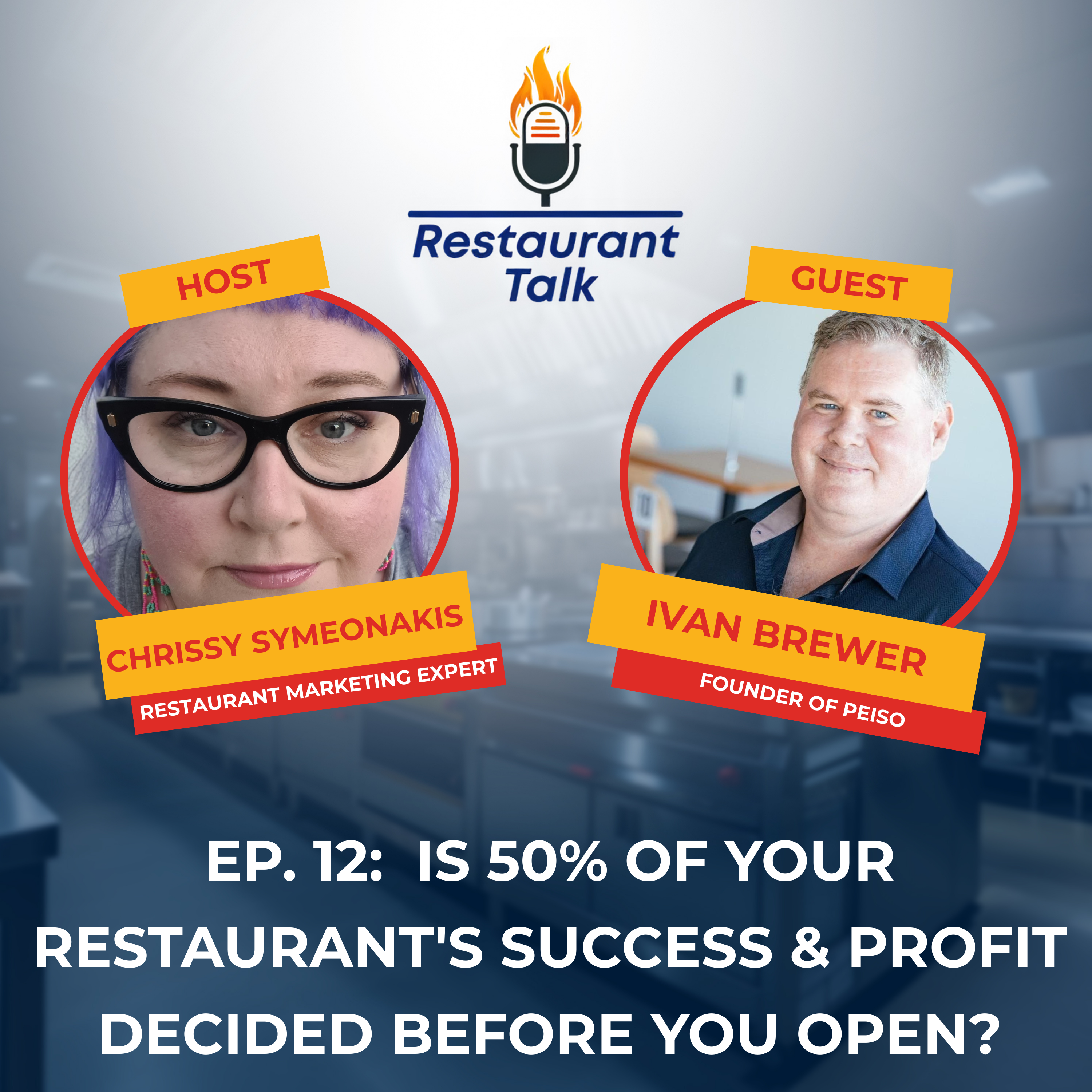
[00:00:32] Speaker B: Hey, everyone, thanks for tuning into Restaurant Talk. My name's Chrissy Simonakis. Yes, that's how you pronounce my last name.
On paper, it's a mouthful, but now you know how to say it. This episode, I'm joined by a very special guest and someone I've known for some time. But today we're digging a little bit deeper and my special guest is Ivan Brewer. Ivan, thanks for being here.
[00:00:54] Speaker C: Absolute pleasure, Chrissy, and just thinking, perhaps we could use your last name as sobriety test.
[00:01:01] Speaker B: I think everyone will be walking the line or getting kicked out. My dad's quite funny actually. Like, he spells it out for people and he goes. It's actually pronounced as Smith.
And yeah, it's a little.
A little running trope in our family. Ivan, thanks for taking time out of your busy day. I know you've got a lot of hospitality experience.
You've been in the industry for some time. So let's jump into these questions and ye. Let's hear a little bit about your experience here in Australia and even abroad. So with over 25 years in the hospitality industry, you've worn many hats, from managing venues to consulting and now leading peso.
How has your perspective on the industry evolved over the years, Ivan?
[00:01:42] Speaker C: Yeah, I think it's a great change and I think I'm now the generation that we really are exemplifying significant change even within the industry itself. So to go right back to the beginning, I kind of fell into it, I think, which is perhaps something that many people do.
My BRAC background was originally just being in sport. Like, I. I grew up with no real goal other than to simply play a sport professionally.
And once I had a really bad injury on my shoulder, moved to New Zealand just really to get out of that scene.
Ended up working in a cafe.
And that, I think was a. A bit of a constant theme in the sense I just happened to work in what was probably the best cafe in Auckland at the time in a coffee industry that was 10 years ahead of anything that Australia was doing. And here's me, little North Queensland, Ivan, who'd never even had a coffee before. Like, why do you have a hot beverage in such a. So I sort of talked my way into it and just loved it. So I Think that right from the beginning I was introduced to Just Smart. And this was a cafe set up by, by Craig Miller, the grandfather of coffee in New Zealand.
And everything from end to end was just phenomenally organized and systematized. And that was probably one of the key sort of event that really cued me to a particular way of thinking about hospitality. And, and for context, I was a barista.
Having overcome my misunderstanding of anything to do with coffee that would make 1500-2000 coffees a day in my seven hour shift.
And to put that into context, baristas now will freak out at 400 coffees a day. Yeah. So I think it was everything that was systematized.
I even had an opportunity to learn how to make coffee in Italy, you know. So I spent five months in Trieste making 3,000 coffees a day on an enormous machine.
And I was then invited to work up into the Regent, which we were just near of because all of their regular customers were senior leadership team there. So went into a top 30 hotel in the world, number one restaurant in the world. So I was very fortunate to be exposed to the real great ways of doing things.
And I just, I just have this phenomenal appetite for learning. So I just, this has been a, a problem for me.
So I would work during the day or during the night in, you know, the region and then I would go down and work in one of the best restaurants in the, in the city as well. So. Well, and that was a gift because I saw what was hospitality like that was not confined by budget.
You know, when you're spending four and a half thousand dollars a night, the, they're not looking at food and beverage as a means of making money and profitability. So it's really the ultimate. And then going into privately run restaurants where it's the complete opposite. Like how can we create this?
So I think that took me to a place where I actually spent a lot of time in kitchens.
I literally just couldn't get enough of it. I just found this fascinating chaos that I've been hoping to try to understand ever since, to be honest. Chrissy. So. And from there I became part of leadership really, really early. So I think I was one of the earliest managers in the region.
24 running this, you know, top, you know, really well awarded restaurant and just threw myself into it all over. So I think that kind of conditioned me then to just have these sort of almost like it, plateau. I need to learn more, move to another, another environment. And everything was just hands on full. And so I ended up into ownership before I was the age of 30 again, sort of naturally read, naturally prominent restaurants.
And then. And I had this appetite to kind of move. I just wanted to get it. I just felt that there was this, not this language that was being spoken by hospitality that just was not something I could really nail down.
Such a deeply complicated space. So, you know, owned cafes would understand events and understand five star, six star, then would go into five star restaurants, then I just would work in bars. For me, it's all just been about how I can learn.
[00:05:49] Speaker B: Yeah.
[00:05:50] Speaker C: Probably the next kind of major event was being in charge of a really large sort of catering company at an early age.
So that kind of took me more away from the tools, more away from the how do I achieve this efficiency and if I could backtrack slightly. Actually, one of the key things that I took from that early hospitality understanding was that we sell an experience. It's a theater. So I used to really love that. It's almost. And I often say this, and it's sort of might not reflect on me well, but how Beyonce will talk about having this kind of like, person Persona that she adopts. She goes onto a stage. I feel like that in hospitality, that doesn't matter what you're feeling behind the scenes. You walk out onto that floor and you're there just to entertain and. Absolutely, yeah. I had this sort of lucky sort of cheekiness that wasn't insulting. And I just had fun. Like, I just love that, you know.
[00:06:44] Speaker B: I can relate to that as well. Like, you know, I would always say to my staff, because I worked in front of house and run some restaurants too, and I would always say to them, the minute that you walk out into that dining room, you're on. You know, you're. You're on stage. You smile, you fake. And I'd always. I would always sugar up my staff, so I'd always bring in, like, bags of sweets and mixed lollies and chocolates. Like, I give them that little sugar hit so that, you know, they'd be at their best doing that. So that's awesome. You've had some really great experience.
Talk to us a little bit about Peso.
So Peso is described as the world's first hospitality profitability software. What inspired you to develop this platform and what gap in the market does it aim to fill? Ivan?
[00:07:28] Speaker C: Yeah, really good question. And I think it was a little bit of a slow burn. I think once I got into management, I then sort of fell into study, you know, sort of. I did a master's and I was blown away by how there is actually so much thought, there's so much consideration and background and research about the details of hospitality, and then there's kind of operations in this other corner of the room. And never the twain shall meet, Right? No one's talking about it. And I'm like, why are we approaching it? Well, I guess my key reflection was, okay, I've been in this industry for like 15 years, entirely through my career. So wherever I've worked in the world, it's been the same kind of narrative, the same sort of like 30% labor, 30% cost of goods.
And for me, that was like, how can that even be possible? Right? So how can different countries, let alone different venues, try to adopt the same one size fits all kind of mantra to profitability? And then reflecting on, well, our profit sucks. Like, as an industry, we've been going backwards since 1995, and it keeps getting worse. So why on earth are we just doing it the same way that we've always done it? So for me, something I say that I'm equally blessed and cursed with the fact that my father was an inventor.
My wife's profit more on the curse of opinion. And I'm probably more towards the blessed that I just want to understand things. Right? So I want to. For me, it's this. Why? Why is this the case?
And really started my adventure then around. Wow. We're really not, I think two things. One, we're just not approaching this the right way. We're not evolving, we're not learning. And as a really quick example, I often talk about, you know, we'd look at our menu engineering techniques, right? So something that's held dear. I know I could point to 30 consultants right now that'll be out there promoting that in the industry.
And nothing against them, but an observation that that was discovered or published first by Krishna and Smith in 1983.
[00:09:21] Speaker B: Yeah.
[00:09:22] Speaker C: Now how can we possibly be doing the same things? And something that's been done since the 80s and really was largely discarded by academia by the 90s. So we just haven't been updating.
And I think for me it was then we're not also giving our staff much of a chance to actually perform. Right. So we are unbelievably complicated as an industry. And something I am very loud about saying, the most complicated industry on the planet. So we're talked down to about how simple hospitality is and unqualified the staff are, et cetera. But we are a phenomenally complicated space.
How do we then help the staff to Help us, Right. So if I was to go to my staff and say, look, we need to take 5% off of the labor the next week, I don't even know what that means. How do I action that? How do I break that down to decision orientated information?
So really that key for me at the start, and we're talking around 2012 13, when I first developed my MVP exaggerated sort of Excel spreadsheet of PACER.
But there was no tech ecosystem. We'd hardly had Internet banking at that stage. So I was just way too early because we need to plug into all of these sources of information. So my whole drive had been around how do I provide information and insights in a way and in a timeliness that fuels better decision making and then is an ongoing iteration is how we sort of informed the beginnings of Peso. And that started me on one, one journey.
[00:10:52] Speaker B: Yeah, amazing. And what was it like going from spreadsheets and formulas to actually developing an app?
[00:10:57] Speaker C: Very difficult process. Especially in my sheer naivety around just the sheer complexity of that.
I think in a lot of ways doing that is relatively simple. Right. The challenge is very disorganized and fragmented information. So we can't get information largely from this really complicated large pool of food tech technologies into a standard language or format or that one spreadsheet. So if you would imagine 50 sheets on this in this Excel, none of them have got the same format, none of them speak the same language. That's the challenge. And I think in a lot of ways that became what PESO evolved into was this translator or standardizer of information because we need to have, yes, point of sale data. But again, there are many conventions within point of sales that are not really something that suits hospitality. So as a quick example, we may not recognize revenue at the point of ordering, only at the point of payment.
Now that's fine in a qsr, but if you and I go out to a lovely meal, we pay 90 minutes later. It's recognizing revenue and hence demand. 90 minutes afterwards the event happened, which renders that information really irrelevant in many ways. The ways in which we will view open till 2am in the morning, many point of sales recognize information on the calendar day. Well, as an industry we want to drag that to the day before to make sense of it. So there's all these little inbuilt and I think my understanding or reasoning behind that is we don't have very many hospitality technologies. They could be in aged care or wherever. Right. So we're just such a specific industry that needs information in Such a specific way. So that's been probably the biggest challenge and the fact that hospitality is not been on the forefront of technology in any way, shape or form. So whether that's technology themselves, not seeing us as an industry that's easy to work with or have embed technology into, and that's probably been the greatest gift of COVID from the hospitality space is it's kind of forced everyone to go, oh, okay, we really need to understand and probably also in a sense to defend venues. Oh my God. You know how hard it is to change point of sales, right?
[00:13:20] Speaker B: Or yeah, absolutely.
[00:13:22] Speaker C: So it's like, we don't want to do that. So, yeah, the challenge has been just how do we. The idea, I think makes a lot of sense to me. The execution is just actually phenomenally complicated.
[00:13:33] Speaker B: Yeah. What's the biggest piece of advice you give to anyone looking to develop their own apps? Like, don't do it. Find something that's already power built. Can you white label, like, what's the situation? There's.
[00:13:43] Speaker C: Yeah, really, really good question. I think if I was to do it again, probably the biggest advice I would give myself was don't choose such a big problem. And that was kind of my own ego going, actually, this is the thing I want to solve.
If it was not something that my heart and soul was in, I would have done something far easier that you could leverage and scale. So I think the narrower the problem, the easier and simpler the problem. Choose that. And it's very easy now in the technology landscape to have an mvp. So we can generate something you don't need with the vibe coding and all the rest of it. We can put something in the front of some users that we can actually test and put it out there anonymously. Say, will you pay money for this? So I think that that sort of stage gating of breaking down an idea and doing it and then really being a skeptic is probably the number one. So do it, but do it. But it's also, if this is in any way, shape or form successful, this is then going to take over your life and it's going to be very difficult.
[00:14:44] Speaker B: Good advice.
[00:14:45] Speaker D: Every day, fryer drains your profits. Dump, buy, repeat, Frylo ends the cycle. This small device sits in your fryer, doubles oil life and cuts costs by up to 50%.
The result, crispier, lighter, less greasy food.
No risk, nothing up front, no ongoing maintenance costs. Visit save fry oil and stop deep frying your prop profits.
[00:15:15] Speaker B: The hospitality industry has faced numerous challenges, especially in recent years.
What do you believe are the most pressing issues currently and how can businesses adapt to overcome them?
[00:15:25] Speaker C: Another very good question, Chrissy.
[00:15:28] Speaker B: I put my thinking cap on today.
[00:15:31] Speaker C: I think if we were to think about the promise of technology.
While I've had the pleasure and the honor of working very closely with a lot of very, very big businesses and a lot of venues and we have a very.
I almost see them naked right. When you talk about profit, it's a very intimate relationship. And what I've seen is this massive increase in technology spend but no actual increase in profitability.
[00:15:55] Speaker B: Oh, wow.
[00:15:56] Speaker C: So we're not necessarily choosing technologies in a way or there isn't been technologies that are actually leading to a better outcome. And for me the only outcome is profit.
I don't care about anything else. It's like we need you to be more profitable. And the reason that I'm so attached to that is I think that solves everything.
And we have a phenomenal. If you're talking about crisis, I don't actually think there's been a worse time in the last 25 years.
Ironically, we are an industry literally born from crisis and from revolution and from paradigm shifts. If we sort of go back to the French Revolution, which is really when true hospitality was born. When we talk about that sort of era in the sort of mid to later 1700s. So we have often done that. This is where we come from.
We are in a place now where it has never been more difficult. All of the things.
So we work with major restaurants, they go, I know how many covers I'm doing each week. That's non negotiable. The Tuesday that used to be busy is no longer busy.
We even saw it as a very, very recent use case. And because we work with venues nationally, we had this really unusual August, right? So August was quite busy, going, okay, cool. This doesn't happen very often. You get to Father's Day, it has died. So we've talked, we've seen venues with trading that's dropped, not been as low since COVID So what's going on? So this is like literally right now we're experiencing something that we've just not experienced over the last number of years and that probably started in the so called festive season or peak season of last year, which was incredibly short, you know. So we had venues not kicking off to that second week of December where it would normally be that sort of middle of November going off. So one of the greatest challenges, okay, patterns are gone.
So we have to, to drastically shorten our decision making horizon. That that is the Number one thing that we need to do, and data is a way of doing that, but data.
So for us, we can't be sort of prescriptive in the insights that we provide, nor can any technology, because Otherwise I'd need 70,000 different versions of the technology to be able to communicate that. Because literally the same restaurant side by side would be profoundly different, even down to skill set, equipment, layout, all of these sort of things that are in there. So I think to really understand what we're doing, but we need to understand that it's idiosyncratic to ourselves. And like sort of key number, it's a key bit of advice at the moment would be 50% of your profitability is decided before you even open the doors.
[00:18:25] Speaker B: Yeah, agree.
[00:18:26] Speaker C: You know, we're not just making the right decisions with that. And the really great venues understand that everything is up for negotiation so that it'll take six months to figure out a new menu. But, you know, so we have a business model, service styles, everything needs to be up. And my main criticism, challenge I think I've seen in hospitality has been the vague bullshit that we adopt. Right, so good food, good service.
So what does that mean if we follow that as a logic? Well, that we can get a grid in service rider and a one staff member per customer. Is that what good or. So we don't. We. We tend to hide behind this really high spend sort of veil and we have to get the best ingredients. Whereas to me, true chefing is taking less expensive ingredients and turning them into something people will pay for. So moving away from these white kind of narratives and paradigms, I think is the number one thing we need to challenge ourselves on.
[00:19:22] Speaker B: Yeah, from a. That's really great insight and advice and it's interesting. Like, obviously I wear the marketing hat, so working with venues on their social digital marketing plan strategy and, you know, like, Melbourne Cup's coming up.
And for anyone that's listening internationally, Melbourne cup is a big horse race held in Victoria in Australia.
It's a public holiday in Victoria. In the rest of the States, most of the states in Australia, it's just a day to go out to lunch, you know, wine and dine for the afternoon, get guzzied up, probably get a bit too pissed and then put a bed on. And we've seen over the years now drastic declines in Melbourne Cup. A lot of it's to do with, you know, staff are working remotely, so they're not coming into the office.
A lot of businesses have their own inbuilt, you know, hospitality Boardrooms and kitchens in big corporate spaces. And then there's also the animal cruelty angle where a lot of people don't want this event. And I can remember, you know, working with venues, this was their bread and butter for the year. Like these big days were huge and they make, you know, hundreds of thousands of dollars. But, you know, I expect in the next five years venues won't be doing it and they'll be doing, you know, like I've seen a few venues already doing this nut to the cup or fuck the cup. Like, you know, so there's definitely needing to be these redressing of events or revenue or experience because the marketplace is very much being dictated to by the customer and consumer.
We've talked a little bit about. Tell me why data driven decision making is integral to running a successful business. Like, you know, why do people in their restaurants need to know the numbers and, you know, make decisions around that?
[00:21:09] Speaker C: Yeah, I think it's a great question. I could probably go back to that kind of first time I was really P and L responsible, you know, for a sort of big venue and even sort of, you know, before that, as I was getting into that understanding and again, completely foreign to me as a. Where I sort of began my career. And I think as an analogy, you could say, look, what you think is happening is not happening.
And it's also why I'll often see an accountant who doesn't understand the. And almost very few do. No disrespect to any accountants because, hey, like, if we followed their advice, there would be no hospitality industry. Right. But you can see that, oh well, you weren't very busy also. Well, the service could just be messy, right? There are those services, as you know yourself, and I'm sure listeners do that. It's just a shit fight. The way customers come in, they're just. And you just work really hard for not a lot of revenue the following week and go, wow, that was easy. You did twice the amount of revenue and you didn't even break a sweat. So, yeah, data is an, is a perspective and I think as is consistent with a statistical model, the narrower you view any bit of data, the less applicable it actually is. We need to look over information and trends. So I think data is incredibly important and it just helps complement the understanding. And that's why I've taken a particular angle with PACER around not being prescriptive. It's really there to. What I say is that your, your, your managers, your owners, they are the experts in their venue. They. It's Just how do we analyze and, and facilitate the dissemination or understanding of that information that then fuels better decisions. And there'll often be things, something I talk about almost every day is that you'll see this roster, right? And I go, well, Wednesday, Thursday, have the same amount of revenue. You're not receiving any stock. You're not. So why does one day have 12 hours more labor than the other, you know, and what I've found is our industry lives off two things largely, right? So Excel or Google sheets and copy and paste, that is pretty much how we go. So we don't really. And I think this is a mental fatigue where we're so busy we've got more to do than time to do it. So we take shortcuts because that's what we do as human. We just bring forward that pattern that we haven't reevaluated for the last two years and we just can't do that. And we need to use data to do that.
[00:23:22] Speaker B: Yeah, that's lazy. And I think it also comes down to like, I used to hate a P and L until I actually was taught by one of my mentors and my bosses on how to, how to read it and how to forecast and not to be afraid of it. And I'm a massive data nerd now. Like, I love the POS data, I love segmenting that data. You know, from a marketing perspective, we can just, the more we refine and the more that we dive down deeper we can make, you know, our customers have a better experience.
Yeah, it's really good.
In your experience, what common mistakes do hospitality businesses make when it comes to profitability and how can they avoid them?
[00:24:01] Speaker C: Yeah, good question.
And something I'm, I'm really talking about almost every day is I think again, if we sort of roll in a little bit, as I mentioned before, you just got to get clear about how, what is your pathway to profitability? Right. So there's a lot of ego go involved in hospitality and I think it's really, it's a bit of a small business thing, I think.
And one of the conditions you have is like you to start anything, you're going to have a lot of people say no, you shouldn't be doing that, et cetera. So you need to have this phenomenal self belief and this, you know, be able to bring that into reality. But that same sort of Persona that doesn't accept advice needs to at some stage learn how to explore how much information we're receiving and what we're doing. So we need to constantly Understand and measure.
And these customers, that's our market, they are telling us a lot of information, as you well know. So when we launch that menu, we don't. No chef on the planet knows what's going to happen in advance.
Right. So. And then even we could have quite a. What seems to be a successful menu, but there'll be items that aren't performing particularly well. Do we understand why do we all of these events that are occurring within that. So for me it really even comes down to how we design for efficiency. So I'm a massive fan of the theory of constraints, like. So I understand or conceptualize hospitality to being. We are a manufacturing facility in the kitchen and I've got a chefing background. So no disrespect to anyone, but that is what we are, right? So we have a predictable thing that we sell. We just have it in a. In a dynamic way in which the demand sort of comes in and we've got perishable industry.
So someone ordering off menu, we should not facilitate or celebrate because that can absolutely block up the fact that you've got this manufacturing facility and we've got an awful lot of pressure coming from there. So I think understanding your business model, understanding the fact that your customer say, I've had a seafood restaurant and had someone come in with a seafood allergy, no, I'm not going to serve you. Like, I'm not subservient to you. I've got a proposition and it might not suit anybody, but not only is your life at risk by trying to dine here, but that's not something we can accommodate. So we have to contain that and understand.
And I've often sort of taught my managers too, that you might have a customer that be loud, abusive or whatever. Well, my job is not to service them or serve them. My job is to maintain the environment for all of my customers and my staff. So that person gets asked to leave. So I think, as you said, that laziness. I think we have to be more dynamic in our thinking. We really need to kind of refresh and I sort of see that as just this erosion of enthusiasm because of the sheer challenge and dynamism of the industry where we've put our heart and soul into it. We're not getting any better results. You keep doing that, we're not getting any better results. Become a bit sort of ambivalent to it all. We kind of need to re. Engage and re love it and realize that technology is through the prism through which we can succeed. So we need to Embrace the right technology in the right way.
[00:27:02] Speaker B: Yeah, awesome.
Looking ahead, what trends do you foresee shaping the future of hospitality and how can businesses prepare for them? So obviously AI is like on everyone's lips at the moment. Like I went to an event last week and we're talking about AI, AI, AI. What, what do you feel about this or what do you see coming our way that we just can't avoid?
[00:27:24] Speaker C: Yeah, good question. And I think there's a big challenge for AI and hospitality. So if we think about just how difficult it is to access organized data. So if I was to pretty much pick any restaurant in Australia right now and go into the back of their back of house, their point of sale will be an absolute shit fight of data.
[00:27:41] Speaker B: Yeah, absolutely.
[00:27:42] Speaker C: We had one venue not long ago, a group, 640 menu items, they had 64,000 variation of those menu items because it'd be different spelling, blah, blah, blah, blah. AI can't handle that. Right. So clean data is what we need. AI can't do anything without that. There is a phenomenal amount that we can facilitate. So I think in your industry is going to be a real challenge. You know, accounting, marketing, legal, they're things that they will tend to go and leverage on AI. I think we don't influencers, they're dead. Like why would I need that when I can just generate myself, you know, an awful lot cheaper? So I think a lot of those things are even, you know, I could put it. And I've, I've been massively nerd like in my AI as well. So I could go and find out anyone's insta within a feed, what they're doing, analyze it all and go and do it myself.
So I think there's huge amounts for that.
I think the context now is going to be quite brutal. I think that globally the industry is really hard. So we've got massive increases in costs. Australia has seen a phenomenal growth in explosion in a number of venues.
We've had no increase really in the actual, the amount people are spending. So we simply, I think on average I worked it out last, we're getting about 300 grand less per venue per year, which is phenomenal. Right? Yeah, we've lost a whole generation of staff.
So we have very young managers. We don't have that cohort of learning anymore, whether it be, you know, move into a group of peers that could help teach them. So I think being able to empower people but also really being able to share what the industry really is. So if we want to do Customer service, for example, how do you do great customer service in an efficient manner? They're actually very contradictory and competing things. So talk to that customer, but don't talk to them too much. So I think being able to frame what we're wanting and building out this understanding of our business model is going to be absolutely paramount. I think AI's got a lot to do with that and even a big tool in analyzing and making sense of our information. So I think it sounds, it's going to still be a journey of how it can leverage because I'm. I still haven't seen a change right. In the sense that huge spend, no increase in profit. AI is very expensive in any meaningful way and the endless tools that are available there is the potential of it, I believe. And I am seeing a reduction in head office sort of expense and headcount and allowing the head office getting out into the field and getting out in our venues more is. And that is something I think is going to be consistent and enhancing how it is and where it is we spend our time.
[00:30:19] Speaker B: Yeah, amazing.
Tell me, what's your favorite experience that you've had as a hospitality customer?
[00:30:27] Speaker C: Great. Yeah, I'll do one as a staff member and it's just being a geek as a staff member. So, you know, worked in a restaurant for a number of years. Very, very high profile chef.
I left and probably one of the most significant moments I've had in my career was when I was like chef going. I was, you know, literally leaving leav in the country for him to come over, shake my hand and say, look, just call me Michael. Like for anyone in the hospitality. That was just an absolute like kind of classic moment.
You know, this is a human to. To be invited into his world directly as a customer. When I was living in the uk, so living in London, worked in a lot of venues over there as, as I have my is my way.
My wife was invited with her work, she worked in Knightsbridge to the little restaurant. I got to join her, which is lovely.
It wasn't particularly busy lunch. So the chef, the owner sort of came and joined us and we sort of chat for 40 minutes and I'm in the corner having heart palpitations and having a stroke because that's Marco P. White sitting opposite my wife, you know, and I couldn't even really verbalize do you know who this actually is?
And I think, you know, absolute rock star person and human. One of the biggest influences on the industry of all time and still being involved in that. So through, you know, and I've met Gordon. I've worked with a lot of very high profile chefs in the past, but that would probably be the, the, you know, the biggest sort of nerd out moment for me.
[00:31:50] Speaker B: Your, your fanboy moment. And you couldn't even like sneak a sneaky text or anything because that was probably before texting on phones and not to age you.
Now, this question we ask all of our guests that come on the show. Ivan. So think, think about this one. If you could give day one you a single piece of advice, what would it be?
[00:32:11] Speaker C: That's a really good question. And for someone who's just been addicted to doing things, I've never been able to stop much, I think, and it was probably more of a personal thing than a professional thing is I just think go all in. I just think be fearless. And I think that that would be, as a younger person, it's something I would say to my kids now because I think, as we all know, no one really gives a shit. And people are more absorbed in their own world and reality now than they ever have been. I just think have a go. Like, just be, really live, really take advantage of this wonderful opportunity that we have called life. And for me, like, I broke my neck eight years ago, right? So that took me out of hospitality, nearly killed me, changed my life forever. And that was obviously very unpredicted event. So I would simply say go at it. Don't hold anything back. Be 100% all the time. Change as often as you need to. Don't, just don't be embarrassed. Just go out and have a decent crack at it.
[00:33:04] Speaker B: Yeah, I love that. And I, and I feel like as well, you know, know, changing places and doing different things is great for your career. Like, you know, different mentors. Like, you know, my brother, one of my brothers, well, all my brothers are chefs, but my youngest brother did an apprenticeship and we sent him to work with our other brother. We sent him to other restaurants, like, just to have a look and a few. Because what you don't want to do is stagnate and get jaded and then have a dislike for hospitality. So I feel like, yeah, going all in, being fearless and just absorbing as much information as you can as possible. Ivan, it's been an absolute pleasure to have you with me today.
You've answered some, you know, I thought I threw a few hard questions in there, but you, you know, gave. Gave me what I needed.
Thanks so much. And everyone listening.
There are other episodes of Restaurant Talk with my co host, so definitely check those out and we'll be back again soon. Thanks so much for listening.
[00:34:04] Speaker C: Thank you.
[00:34:04] Speaker A: Thanks for tuning in to Restaurant Talk. If you enjoyed the episode, please follow, subscribe and share. Thanks to our sponsor, Save Fry Oil. See you next time.